
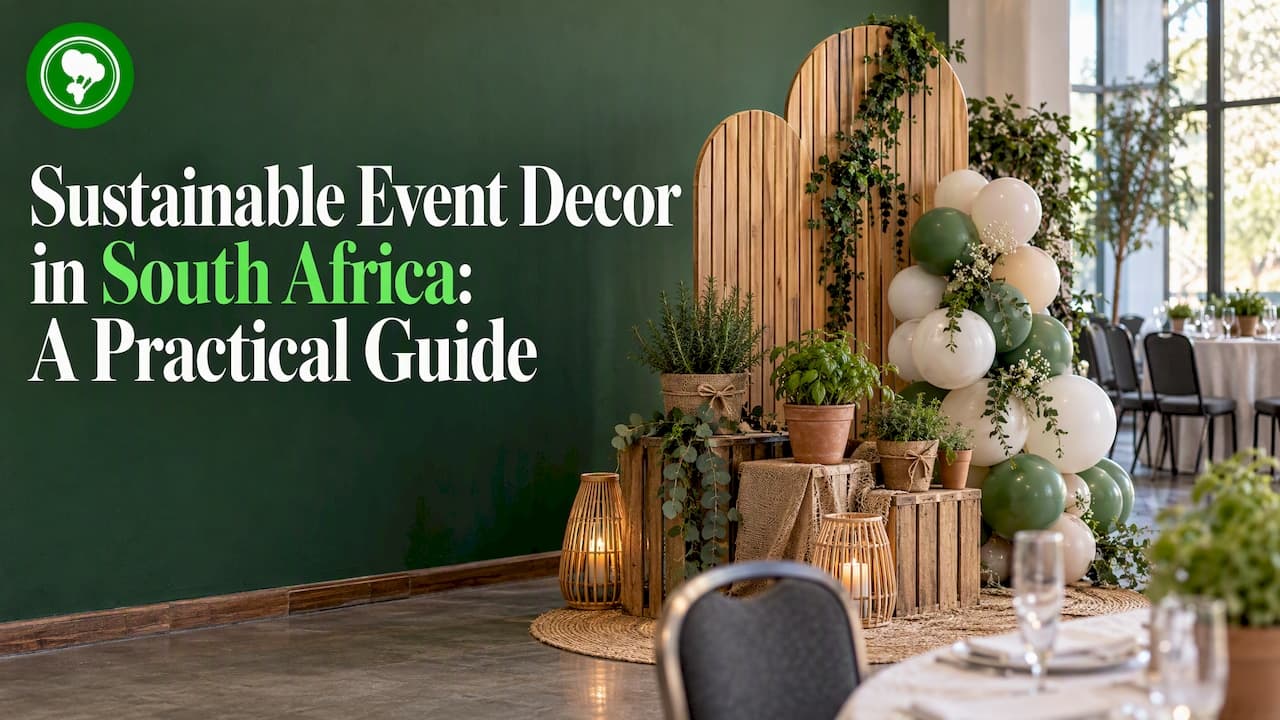
Sustainable event decor means decor you can reuse, recover or dispose of responsibly, chosen during planning rather than bolted on at the end. In practice: favour durable and reusable pieces, replace single-use items, ask suppliers hard questions about materials, and make a waste plan before the day. This guide covers what works at South African weddings, corporate functions and promotions, including an honest look at balloons, which we make for a living.
TL;DR
- Start with reuse: modular structures, cardboard furniture, living plants and generic (undated) signage beat anything disposable.
- "Biodegradable" is not a free pass. Keep balloons indoors, tied securely and put in the bin. Never release them.
- Many South African municipalities now ask for a waste management plan before approving public events.
- Ask suppliers what is in the product, not only what is on the label: additives and coatings are what slow breakdown.
- Measure energy, water and waste. What you track is what improves from one event to the next.
Table of Contents
- What "sustainable" really means for decor
- Start with reuse, not recycling
- The balloon question, answered honestly
- How to spot greenwashing before you pay
- Decor that works without helium
- Plan the waste before the day
- Our perspective
- Sustainable decor for weddings, corporates and promotions
- Where our range fits in
- A short checklist
- FAQ
- Sources
What "sustainable" really means for decor
The City of Cape Town's Smart Events Handbook describes event greening as building socially and environmentally responsible decisions into the planning, organisation and delivery of an event. The key word is planning. A venue dressed in green-labelled products but with no thought for transport, waste or storage afterwards is not a sustainable event.
There is also a shift in thinking. Sustainable decor used to mean "recyclable". The more useful idea now is circular: items built to be reused, refurbished and kept in a loop, so that disposal is the last resort. The CSIR's work on circular, locally built materials reflects the same direction. For decor, that means choosing furniture, signage and accessories that are physically durable, not just products that eventually rot.
The local event-greening minimum standards define a sustainable event as one where organiser and client take responsibility for protecting the natural environment, respecting local cultures and contributing to stronger local economies. Decor is one part of that, but it is the part guests see, so it sets the tone.
Start with reuse, not recycling
The cheapest sustainable decision is the item you never throw away. Approaches that work well in South Africa:
- Reusable structures. Modular stands, frames, arches and backdrops that can be rebuilt in a different configuration for the next event.
- Cardboard furniture. Flat-packed, light to transport and recyclable. Even the Electoral Commission has tendered for cardboard tables and chairs in packs of one table and two chairs, which shows the format is practical at scale.
- Locally sourced items. Less freight, and it supports local suppliers. Think indigenous plants, hired linen and locally made ceramics.
- Living elements. Potted plants and herbs can go home with guests or back to the nursery. Cut flowers are fine too if they are composted afterwards.
- Generic branding. Signage and banners without dates or one-off slogans can be used again at the next event. Digital signage replaces printed boards where it makes sense.
- Reusable catering basics. Water dispensers instead of plastic bottles remove one of the biggest waste streams at any function.
This list reflects the guidance for sustainable events in South Africa published by the City of Cape Town, which also stresses separating waste at source. The same handbook's festival example is hard to argue with: at one Cape festival, 92% of waste was recycled because it was sorted where it was created.
The balloon question, answered honestly
Balloons are the most visible and most argued-over decor item at South African celebrations. Here is where the science actually sits.
Latex comes from rubber tree sap, so it is a natural material. But a study of balloon degradation in freshwater, saltwater and compost found that latex balloons behave like plastic in the environment. Breakdown was uneven, and balloons often kept their original size and shape. Standard manufacturing adds vulcanising agents, antioxidants and other additives that can slow the process.
Imperial College London researchers say standard balloons can take years to break down and can release harmful chemicals. They are working on a fully biodegradable alternative, which tells you the industry has not settled the question.
What does that mean for your event?
- Never release balloons. Whatever the label says, a released balloon becomes litter. The Queensland government's factsheet notes balloons have been identified as one of the most harmful waste items for wildlife, and the point holds anywhere with coastline, farmland or game.
- Keep them indoors and secured. Tie them, weight them, collect them at the end.
- Treat them as waste. Burst and bin them. Do not leave them on the lawn.
- Choose natural latex made without unnecessary additives. Guidance on event balloons suggests plant-based natural rubber latex over alternatives, and plastic-free options such as bubbles or light shows for outdoor moments.
- Use fewer of them, better. One well-designed installation does more than a hundred scattered across tables.
Our own detailed notes on how long biodegradable latex balloons stay intact and on why "biodegradable" can mislead when comparing foil and latex go further if you are weighing the options.
How to spot greenwashing before you pay
Researchers quoted in the BBC piece above point out that shoppers are regularly confused by "biodegradable" labels. A product can be called natural and still contain additives, heavy metals or coatings that stop it from breaking down. A few questions cut through this quickly:
| Ask the supplier | A good answer sounds like | A weak answer sounds like |
|---|---|---|
| What is it made from? | A named raw material, such as natural rubber tree sap | "Eco-friendly materials" |
| What else is in it? | A clear statement on additives and coatings | Silence, or "it's all natural" |
| Is it certified for safety? | A named standard, such as EN71 for toys and balloons | "Fully tested" with no detail |
| Can I reuse it? | Yes, with storage and care advice | "Single use only" |
| What do I do with it afterwards? | Clear disposal guidance | "It will just break down" |
The last row matters most. A supplier who tells you biodegradable balloons are fine to let go is not being straight with you.
Decor that works without helium
Helium is a finite resource and a cost driver, and a tank is not always practical at a rural venue. Plenty of polished balloon decor needs none of it. Garlands, arches, columns and table clusters are held up by structure, not gas. We have written about helium-free balloon ideas, how sticks and string compare as supports, and how helium and air balloons differ in float time and safety.
Float time also affects planning. Our guide to how long latex balloons last covers standard latex against Hi-Float treatment, so you do not over-order "just in case". Over-ordering is a quiet source of waste.
Plan the waste before the day
Sustainability is also a permit issue. Municipalities such as Cape Town and Saldanha Bay increasingly expect organisers to manage their own waste streams and restore the site afterwards. Saldanha Bay's event permitting policy covers the clearing and cleaning of event locations. If you are applying to use a public or municipal space, expect to be asked for a waste disposal plan. Check your own municipality's current requirements before you commit to a venue.
A simple decor waste plan covers:
- What comes in: a list of every decor item, and whether it is hired, reusable, compostable or single-use.
- Who handles it: one named person responsible for collection at close.
- Where it goes: bins separated for recycling, compost and general waste, placed where the waste is produced.
- What comes home: reusable items cleaned, counted and stored for next time.
The Cape Town handbook also recommends measuring energy, water and waste, so you can compare events. Weigh your waste after the first event. The second one will be better for it.

Our perspective
We make biodegradable latex balloons from sustainable rubber tree sap, so we have every reason to tell you balloons are fine. They are, but only when used properly. Natural latex made without a cocktail of unnecessary additives is a better starting point than the alternatives, and our balloons are 100% natural and EN71 certified. That is where the claim stops. No balloon belongs in the sky, the veld or the sea.

What we see in the field is that sustainable decor fails less through bad materials than through bad planning: too many items, no collection plan, balloons left on the lawn. A single, well-built installation in a wide range of colours (we offer over 50) usually does more for the room than scattered extras, and it is easier to clear up.
We also think suppliers should be asked more questions. Ask us what is in our products, how to dispose of them and how long they will last. If the answer is vague, move on.
— Richard
Sustainable decor for weddings, corporates and promotions
Weddings. Choose a hero piece, such as an arch or floral wall, and keep the rest quiet. Potted herbs as centrepieces double as favours. Use balloons indoors for the reception and skip the confetti toss and sky release.
Corporate events. Generic, undated branding is the biggest saving. A banner that says your brand, not the 2026 conference, can be used all year. Reusable stands and modular displays suit launches and trade shows.
Promotions and kids' events. Printed balloons and branded giveaways work hard for a brand, but they only reflect well if they are handled responsibly. Pick natural latex, give out clear disposal guidance and avoid releases at activations. For restaurants and family venues, balloons and branded items can lift a kids' menu without adding to the litter, provided staff collect them.
Where our range fits in
If you want balloon decor that matches the approach above, our biodegradable latex balloons are made from sustainable rubber tree sap and come in over 50 colours, with custom printing for promotional use. We also supply accessories, branded stress balls and shakers, and custom inflatables, and our national network of decor teams supports weddings, corporate functions and promotional events. Browse the full product range, or start at our biodegradable latex balloons page. For foil and colourful latex options, see the shop.
Two practical guides help with set-up: balloon sealing methods (tie, clip or valve) and preparing latex with gel the day before. If you want to match a colour palette, our note on double stuffed balloons is a good start.
A short checklist
- Set sustainability goals at the planning stage, not the week before.
- List every decor item as reusable, recyclable, compostable or single-use. Cut the last category first.
- Choose generic branding that survives more than one event.
- Ask each supplier what is in the product and how to dispose of it.
- Use balloons indoors, secured, and collect them afterwards. No releases.
- Write a waste plan, and check your municipality's permit conditions.
- Weigh your waste and note what to improve next time.
FAQ
What are some eco-friendly party decorations?
Potted plants, reusable fabric bunting, paper-based decorations, hired furniture and natural latex balloons used indoors all work well. Choose items you can reuse or return, and avoid glitter, confetti and plastic table scatters. Keep the number of items small so there is less to clear up.
Are biodegradable balloons really eco-friendly?
Only in the right context. Latex is plant-derived, but research on balloon degradation shows that breakdown in water and compost can be slow and uneven. Natural latex without needless additives is a better choice, but balloons must still be kept indoors and binned, never released.
Do I need a waste plan for an event in South Africa?
If you host in a public or municipal space, you are likely to be asked for one. Municipalities such as Cape Town and Saldanha Bay expect organisers to manage waste and restore the site. Contact the events office of your municipality for its current requirements before you book.
How do I make branded decor more sustainable?
Keep the branding generic so it can be reused across events, and favour durable materials over one-off printed items. Where you do use printed balloons or giveaways, choose natural, certified products and tell recipients how to dispose of them.
Sources
- City of Cape Town Smart Events Handbook
- City of Cape Town
- Saldanha Bay Municipal event permitting policy
- Event greening minimum standards 2017
- CSIR: wattle brick community centre
- Electoral Commission cardboard furniture specification
- Latex balloons do not degrade uniformly in freshwater, marine and composting environments
- BBC: Scientists invent 'world's greenest balloon'
- Queensland Government balloon litter factsheet
- The Blue Standard: balloons