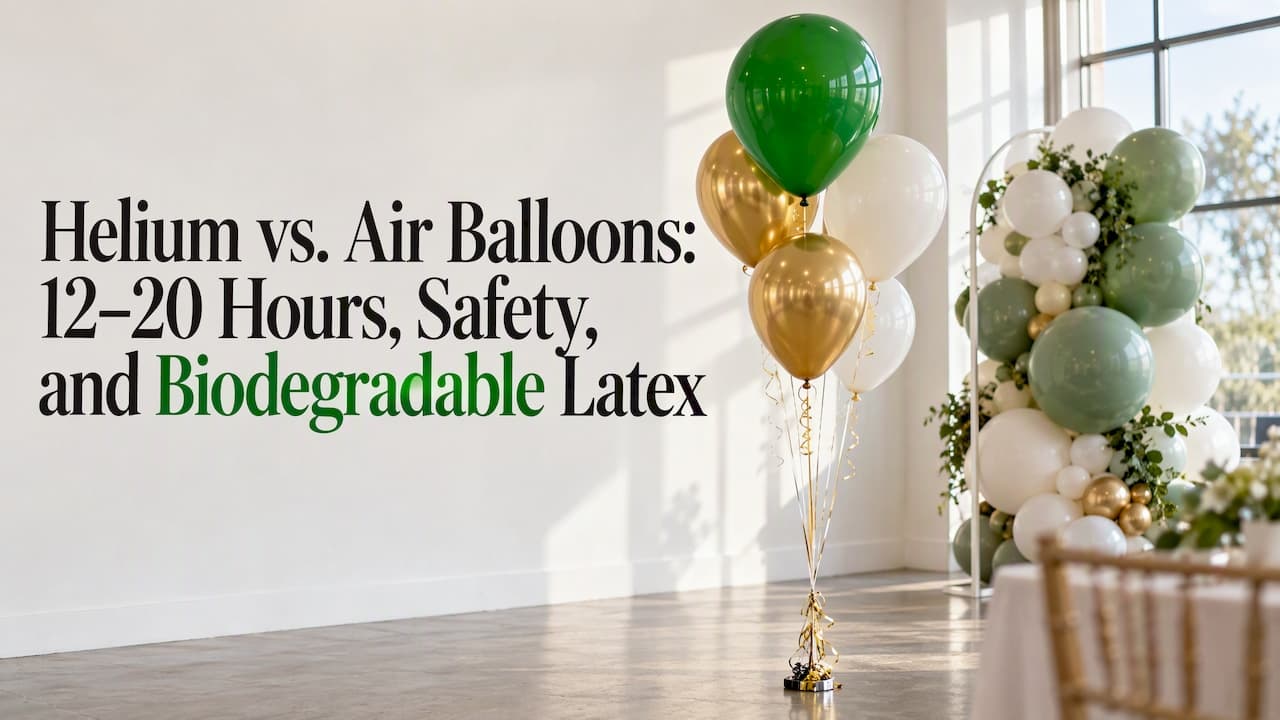
Choose helium when you need balloons that float, drift or hang in mid-air for a focal display. Choose air when you want long-lasting garlands, columns or arches that will survive hours or even days without drooping. The real trade-off comes down to float duration, cost and environmental impact, and the right answer usually depends on which of those three matters most for your event.
TL;DR:
- Untreated latex balloons float for about 12–20 hours, while helium filled foil balloons can last several days because their coating slows gas loss.
- Inflate air garlands and columns the day before an event, but fill helium balloons near the start because heat and handling shorten their display life.
- Reserve helium for a few floating statement balloons and use air for larger structures, reducing cylinder costs while keeping most décor grounded.
- Weight foil balloons securely because their conductive coating can cause power outages if they reach overhead lines, and never release balloons outdoors.
- Choose certified biodegradable latex instead of foil when the design allows, and retrieve every balloon after the event to reduce litter and wildlife risks.
Table of Contents
- How helium and air make balloons behave
- Float time: what to expect from helium versus air
- Cost and availability: when helium earns its price
- Safety and rules to check before you inflate
- Environmental impact and making the responsible choice
- Getting the best result: filling, sealing and timing tips
- Why biodegradable latex changes the calculation
- Balancing the look you want against the planet and your budget
- How we can help you get it right
- FAQ
- Sources
How helium and air make balloons behave
Helium is lighter than the surrounding air, so a balloon filled with it experiences upward buoyant force and rises until the weight of the balloon and any attachments balances that lift. Air-filled balloons have no such advantage: they sit at the same density as the room around them, so any floating effect has to come from a frame, a stand or clever stacking rather than the gas inside.
Material matters just as much as gas. Latex is a natural, slightly porous skin, so helium molecules slowly work their way through it. Foil, often called mylar, is a metallic-coated film that holds gas far longer because it is far less permeable, which is why foil balloons tend to stay firm for longer regardless of what fills them.
The fill method changes the outcome too:
- A hand pump works for air-filled décor but cannot pressurise helium enough for a clean float.
- A helium cylinder, either bought or hired, is the standard for floating latex and foil balloons.
- A compressor suits large air-filled structures like columns and arches where consistent firmness matters more than lift.
- The seal, whether a simple knot, a plastic clip or a self-sealing foil valve, affects how much gas escapes before the display even goes up.
Float time: what to expect from helium versus air
Helium-filled latex balloons typically stay visibly full and floating for around 12 to 20 hours before they start to sag, though smaller balloons lose lift faster than larger ones. Foil balloons filled with helium last considerably longer, often several days, because their coating resists gas loss far better than latex.
Pro Tip: A sealant treatment such as Hi-Float, brushed inside a latex balloon before inflation, can extend float time well beyond the untreated average by slowing how fast helium escapes through the latex.
Air-filled displays play a different game entirely. Because they are not relying on buoyancy, a well-built garland, column or balloon frame can hold its shape for days or weeks indoors, limited mainly by slow deflation and fading rather than float loss.
Three factors decide how long any balloon actually looks good:
- Size: larger balloons hold gas proportionally longer than small ones.
- Temperature: heat accelerates gas permeability and expansion, while cooler air slightly increases buoyancy and can make balloons feel firmer for longer.
- Treatment and weighting: sealants and correctly placed weights reduce stress on the balloon skin and slow leakage.
Cost and availability: when helium earns its price
Helium filling carries ongoing costs that air filling simply does not. A cylinder purchase or rental, plus either a professional fill service or a refill fee, adds up quickly for anyone filling balloons regularly, whereas a basic hand pump or compressor is a one-off purchase that keeps working indefinitely.
Availability follows the same pattern:
- Helium cylinders and fill services often need to be booked ahead, especially around busy event periods.
- Air is available everywhere, instantly, with no supplier dependency.
- Hand pumps and compressors store easily and need no special handling precautions.
- Helium cylinders are pressurised and need secure, upright transport and storage.
Pro Tip: If your display mixes a few floating statement balloons with a larger air-filled structure, you can order a smaller helium fill and save most of your budget for the air-based build.
Safety and rules to check before you inflate
Compressed helium cylinders need careful handling: keep them upright, secured against tipping, and stored away from heat sources, since a damaged valve can release gas suddenly and forcefully.
Foil balloons bring a separate hazard. Their conductive coating means a loose foil balloon drifting into overhead power lines can cause outages, which is why they should always be weighted or kept firmly tethered rather than allowed to float free.
Local rules are increasingly specific about this. Municipal guidance on balloon releases now bans releases outright in protected areas, citing both wildlife injury and the power-outage risk from mylar balloons drifting into infrastructure.
For promotional or children's events, safety standards matter too:
- Check for EN71 certification on balloons intended for children or wide public handling.
- South African regulations covering objects intended for children set limits on flammable and hazardous materials in toys and promotional items.
- Never release foil or latex balloons outdoors where they could reach waterways, farmland or protected reserves.
Environmental impact and making the responsible choice
Latex comes from natural rubber tree sap and breaks down far faster in the environment than foil, which is a plastic-coated film that persists for a long time and does not biodegrade in any comparable timeframe. That difference matters because balloons that escape outdoor events, whether released deliberately or by accident, can end up as litter or a choking hazard for wildlife long before anyone finds them.

The same municipal guidance from Overstrand that bans releases in nature reserves specifically flags wildlife injury alongside the power-line risk, which is why releases of any kind are discouraged rather than just regulated for foil.
Helium adds a second consideration: it is a finite, non-renewable gas with genuine industrial and medical uses, so treating it as disposable for a few hours of float is worth rethinking when ground-based alternatives exist.
Practical ways to cut the impact:
- Favour ground-based garlands, columns and arches over floating releases.
- Retrieve and dispose of balloons properly after an event rather than letting them drift off.
- Choose certified biodegradable latex over foil wherever the look allows it.
- Skip releases entirely, even where they are not yet formally banned.
Getting the best result: filling, sealing and timing tips
Getting balloons to look right on the day comes down to a handful of habits rather than luck.
- Seal latex balloons with a simple knot or clip immediately after filling, and use a self-sealing valve for foil to lock gas in without a separate tie.
- Treat latex with a sealant before inflating if you need float to last well beyond a single day.
- Inflate air-filled garlands and columns the day before an event; they hold shape far longer than helium pieces, so there is no rush.
- Inflate helium pieces as close to the event start as practical, since warmth and handling both shorten their best-looking window.
- Anchor foil balloons with a weighted base rather than a loose string, and build air garlands onto a wire or mesh frame for a shape that holds under its own weight.
Pro Tip: Keep both helium and air-filled balloons out of direct sun and away from car boots on hot days; heat expands the gas inside and can pop balloons well before the event even starts.
Why biodegradable latex changes the calculation
Choosing biodegradable latex over foil does more than solve a sustainability concern: it removes the long-term litter and wildlife risk that comes with materials that do not break down. We produce our latex balloons from sustainable rubber tree sap, making them 100% natural and biodegradable, and every line carries EN71 certification so quality and safety are verifiable rather than assumed.
We offer a biodegradable range in multiple colours with custom printing available, providing aesthetic flexibility without the environmental trade-off. For anyone balancing a brand look against a genuine sustainability commitment, that combination is the practical middle ground.

Balancing the look you want against the planet and your budget
Our honest take: pick helium for a handful of floating statement pieces, lean on air-filled structures for bulk volume, and default to biodegradable latex over foil whenever the design allows it. Most events do not need every balloon in the room to float, they need the display to look intentional and leave nothing behind.
— Richard
How we can help you get it right
We make choosing between helium and air easier by offering a biodegradable latex option that works for both. Our biodegradable latex balloons come in multiple colours with custom printing, so a floating centrepiece or a ground-based garland can carry similar branding without relying on foil.

Beyond the balloons themselves, we support the full event through:
- Branded promotional balloons and a premier line of décor balloons for corporate functions and weddings.
- Balloon accessories, stress balls, shakers and custom inflatables for added visual impact.
- Decor teams and nationwide fulfilment through our events, décor and balloon catalogue, covering everything from garlands to bubble and hot-air balloon décor.
- Foil and colourful latex balloons available to shop directly online for smaller or last-minute orders.
If you want a display that looks right on the day and holds up to scrutiny on sustainability, get in touch through our site to plan your order.
FAQ
Is cold air better for helium balloons?
Cooler conditions slightly increase air density, which can make a helium balloon feel firmer and marginally more buoyant for longer, while heat does the opposite by expanding the gas and speeding up leakage. Keeping helium balloons cool and out of direct sun before an event helps them look fuller for longer.
What is the fatality rate of hot air balloons?
This article covers helium and air-filled party balloons rather than hot air balloon flights, which are a different activity involving passenger-carrying aircraft and separate aviation safety rules. For flight safety statistics, a national aviation authority is the appropriate source rather than a balloon decor guide.
How do hot air balloons work?
Hot air balloons use a burner to heat air inside a large envelope, and because heated air is less dense than the cooler air around it, the balloon rises. That is a different mechanism to a party balloon, which relies on helium's lower density compared with ordinary air rather than heat.
Is helium wasted on balloons?
Helium is a finite, non-renewable resource with important industrial and medical uses, so using it purely for short-lived recreational float is widely seen as an inefficient use of a limited supply. Choosing air-filled structures for bulk décor and reserving helium for a few statement pieces reduces that waste without sacrificing visual impact.