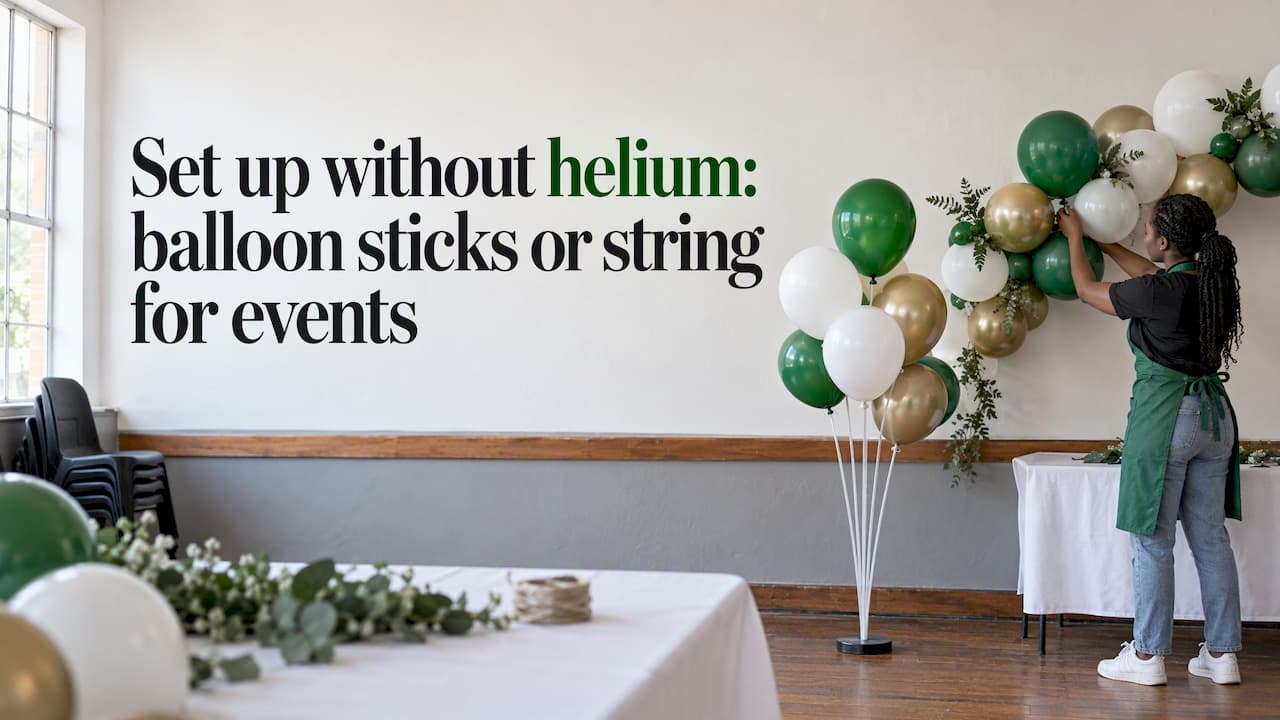
Choose balloon sticks when you need single pieces, giveaways or quick centrepieces that stand upright on their own, and choose string when you want garlands, arches or flowing installations that drape or hang. Sticks give you speed and precision on individual pieces; string gives you flexibility and shape. Below, we walk through how to use each method, what to buy and how to keep balloons looking good for longer.
TL;DR:
- Sticks are ideal for quick, individual displays like giveaways and table centerpieces, especially in indoor settings, but are less stable outdoors in wind.
- String rigging takes longer to set up but offers flexibility for large, flowing decorations like arches and ceiling installations, and holds shape better outdoors when properly weighted.
- Using biodegradable latex balloons with sticks reduces environmental impact, though single-use plastic sticks still generate waste.
- Balloons on sticks usually last one to two days indoors, while string-created garlands can last two to four days if kept away from sunlight and sharp objects.
- For small batches, sticks are more cost-effective and faster, but large garlands benefit from the reusability of string and clips for sustainability and shape flexibility.
Table of Contents
- Quick comparison: when to pick balloon sticks and when to pick string
- How to use balloon sticks correctly
- How to rig balloons with string for garlands and clusters
- Pros and cons: stability, look, speed, cost and environmental factors
- Safety, balloon longevity and common failure modes
- Materials and where to buy
- A decorator's rule of thumb
- How Balloon & Printing Manufacturers can help
- FAQ
- Sources
Quick comparison: when to pick balloon sticks and when to pick string
A "stick and cup" setup holds one inflated balloon upright on a rigid pole, usually seated in a small plastic cup. "String rigging" ties multiple balloons to a line, net or central cord so they hang, drape or cluster into a shape.
Sticks suit table centrepieces, balloon giveaways, aisle markers and stall displays where you need each balloon to stand independently. String suits garlands, arches, balloon walls and ceiling-to-floor installations where the balloons need to flow together as one visual piece.
- Sticks: fastest to set up per piece, minimal labour, but each unit needs its own stick and cup.
- String: slower to rig overall but far more flexible for large, organic shapes once you have the materials sorted.
- Cost per unit tends to favour sticks for small batches and string for large garlands, since one spool covers dozens of balloons.
- Environmental note: single-use plastic sticks add waste, so pairing them with biodegradable latex balloons narrows the overall footprint compared with non-biodegradable options.
How to use balloon sticks correctly
You will need balloon sticks, cups or clips, balloons sized to suit the stick length, and a hand or double-action pump. Most standard cups fit 9 to 12 inch latex balloons comfortably.
- Inflate the balloon to roughly 90% of its full size, leaving a little give in the latex.
- Tie a secure knot and trim the excess neck.
- Slide the knot through the hole in the cup, then clip or twist the cup onto the top of the stick.
- Push the stick into its base, sand-filled pot or table arrangement, adjusting the angle so the balloon sits upright.
For a professional look, stagger stick heights across a table or stall display rather than lining them up flat, and avoid overtightening the cup clip, which can pinch the latex and cause early leaks. A step-by-step video demo shows this process for centrepieces and giveaway stock without any helium involved.
Pro Tip: Use a double-action pump so you inflate on both the push and pull stroke, cutting the time per balloon roughly in half when you are filling a large batch.
How to rig balloons with string for garlands and clusters
For garlands and clusters you will need thin twine or fishing line, clear balloon tape, small plastic clips, and weights or anchors for either end. Fishing line works well when you want the string to disappear visually against a wall or arch frame.
- Lay out your run of fishing line or twine along the intended shape, anchoring one end to a fixed point.
- Inflate balloons in a mix of two or three sizes for a fuller, more natural look.
- Attach each balloon to the line using balloon tape or small clips, alternating sizes as you go.
- Group three to five balloons into clusters with their necks twisted together before tying each cluster to the main line for a garland with more depth.
- Anchor the finished garland to a ceiling point, post or frame using weights or cable ties so it holds its shape under light movement.
Work from the centre outward to keep tension even, and keep spare clips on hand since tangling is the most common hold-up during a long rig.
Pros and cons: stability, look, speed, cost and environmental factors
Sticks hold up well indoors but lose stability outdoors in wind, since a single point of contact at the base gives the balloon little resistance to gusts. String-rigged clusters and garlands anchored at both ends tend to hold their shape better outdoors, particularly when weighted at intervals.
- Design flexibility: string lets you build organic, sculptural shapes; sticks are better for exact, isolated placements such as table markers.
- Setup speed: sticks are quicker per piece and need little practice; string rigging takes longer to plan but scales well for large displays.
- Labour: a single person can manage sticks easily, while garlands and arches usually benefit from a second pair of hands.
- Sustainability: sticks are single-use plastic, so pairing them with biodegradable latex balloons reduces, though does not remove, that footprint, while string and clips can often be reused across events.
Combining anchored, weighted features with hanging clusters helps displays keep their shape in high-traffic or low-ceiling spaces without relying on helium, a practical point for anyone setting up without floating balloons. Professional decorators often alternate anchored, stick-based pieces with string-rigged clusters to balance stability against design freedom, rather than committing to one method across an entire event.
Safety, balloon longevity and common failure modes
Air-filled latex balloons on sticks typically hold their shape for one to two days indoors, while string-rigged garlands and clusters often last two to four days if kept out of direct sun and away from sharp edges. Neither method needs helium to achieve this.
Common failure causes include abrasion against rough table edges, overinflation that thins the latex unevenly, and contact with sharp clips, skewers or jewellery during handling.
Keep small children away from loose or popped balloon pieces, since fragments are a choking hazard. Secure weighted bases properly so stick displays cannot tip, dispose of popped latex in general waste rather than leaving it outdoors, and handle clips and any pointed tools away from inflated stock. Store unused balloons flat, away from heat, and do a quick check of every knot and clip before the event starts.

Materials and where to buy
A practical shopping list covers balloon sticks with cups, string or fishing line, clips, balloon tape, a double-action pump and small weights for anchoring.
- Sticks, cups and clips for single pieces and centrepieces.
- Fishing line, twine or balloon tape for garlands, arches and clusters.
- A double-action pump for speed when inflating in bulk.
- Weighted bases or cable ties for securing both methods outdoors.
Biodegradable latex is the better choice whenever you are using disposable stick setups, since it offsets some of the waste from single-use plastic components. For bulk orders, buying sticks, cups and pumps together as a set usually works out more practical than sourcing them separately, and our product catalogue lists accessories alongside balloon stock for exactly that reason.
A decorator's rule of thumb
For a quick market stall or festival pop-up, we reach for sticks every time: they go up fast and survive being knocked about. For a wedding centrepiece or formal venue installation, string wins, since it lets the shape flow with the room rather than sitting rigid on a table.
— Richard
How Balloon & Printing Manufacturers can help
We supply biodegradable latex balloons alongside the sticks, cups, string and clips you need for either method covered above. Whether you are setting up a single stall display or a full venue installation, our decor teams can support the setup directly.

- Order balloons and accessories through our biodegradable latex balloons range.
- Browse sticks, pumps and clips in our product catalogue.
- Shop foil and latex stock directly on our order page.
Get in touch through any of these pages to order materials or book decor support for your next event.
FAQ
How long will a stick balloon last?
An air-filled latex balloon on a stick typically holds its shape for one to two days indoors, depending on temperature and handling. Keeping it away from direct sun and sharp edges extends that window slightly.
How do you make balloons stick together without string?
Twist the necks of two or three inflated balloons together to form a cluster, then secure the twist with a small clip or a strip of balloon tape. This creates a joined group without needing any string or line.
What is a balloon stick called?
It is usually sold as a "balloon stick" or "balloon pole", paired with a small plastic "balloon cup" that holds the knot in place at the top. The combination is often sold together as a stick and cup set.
What can you use as balloon string?
Thin twine, fishing line or dedicated balloon tape all work well for rigging garlands and clusters. Fishing line is a common choice when you want the line itself to stay close to invisible against a backdrop.