
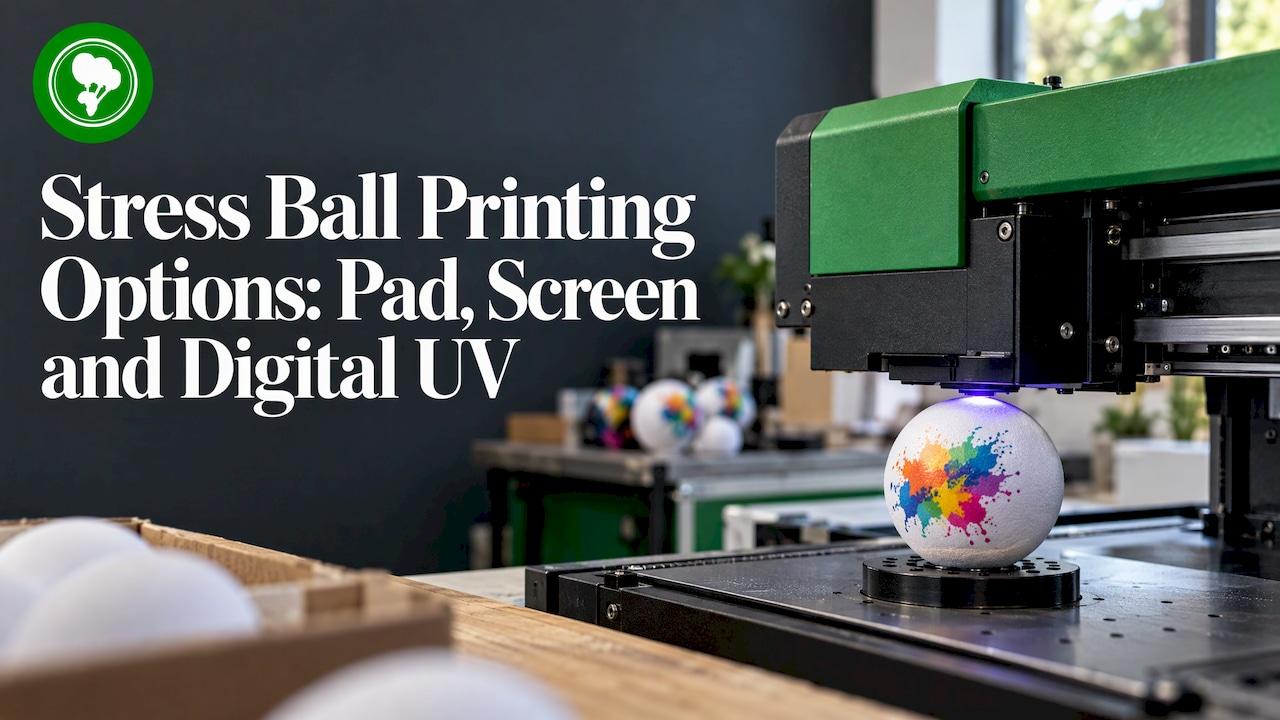
There are three main ways to put your logo on a stress ball: pad printing, screen printing and digital UV printing. For most promotional stress balls, which are small, round and squeezed constantly, pad printing is the usual starting point. It copes with curves and keeps setup cost low. Screen and digital UV suit flatter shapes, or designs with photographs and gradients. The right choice depends on your artwork, your quantity and where the ball will be handled. Below is how each one works, what it does well and how to prepare your file. You can then brief a supplier with confidence.
Key Takeaways
- Pad printing is the default for round and curved stress balls. It suits one to four flat colours and runs of roughly 100 to 10,000 units.
- Digital UV printing handles full colour, gradients and photographs, but struggles with steep curves and recesses.
- Screen printing gives bold, solid colours on flatter or evenly curved surfaces. It needs a separate screen for every colour, so it pays off on larger runs.
- Simple logos in one or two colours print cleanest and survive squeezing best.
- Send vector artwork and approve a printed sample, not just an on-screen proof, before the full run.
Table of Contents
- How a stress ball gets its logo
- Pad printing: the standard for curved surfaces
- Screen printing: bold colour on flatter areas
- Digital UV printing: full colour and fine detail
- Side-by-side comparison
- Which shape works with which method
- Does the print survive squeezing?
- Preparing your logo for a clean print
- Quantity, cost and turnaround
- Our view: keep the design simple, make the item useful
- Order branded stress balls
- FAQ
- Sources
How a stress ball gets its logo
A stress ball is a soft, squeezable, usually foam or similar flexible object with a curved surface. That is what makes printing it different from printing a flat mug or a card. The ink has to reach a surface that bends, stays on when the ball is squeezed, and still reads clearly at a glance.
Three methods are in common use. Each handles curves, colour and quantity differently.
Pad printing: the standard for curved surfaces
In pad printing, the image is lifted from an etched plate by a soft silicone pad. The pad then presses onto the object and deforms to follow its shape. Pad printing reaches curved, stepped, recessed and irregular surfaces, which is why it suits balls, shapes and novelty items.
What to expect:
- Colours: best with spot colours, meaning solid, flat colours such as your brand red or blue. Pad printing is described as best for 3D, curved surfaces with spot colours, and it needs a plate made for the design.
- Size: classic pad systems are limited to images of about 150 mm, which is ample for a logo on a ball.
- Quantity: a 2026 South African printing guide puts the sweet spot for promotional 3D objects at 100 to 10,000 units, because setup is cheap.
- Weak point: photographs and smooth gradients. If your design has them, simplify it or consider digital.
Screen printing: bold colour on flatter areas
Screen printing pushes ink through a mesh stencil. It works best on flatter, more open areas and can lay down a heavier ink layer, so solid colours look rich and opaque.
The catch is that every colour needs its own screen. A four-colour design needs four screens, which adds setup cost. That is why screen printing makes most sense on larger runs, where the cost spreads across many units. On a stress ball, it suits shapes with a flat or only gently curved face, such as a cube, a flat-sided shape or a keyring-style piece, rather than a fully round ball.
One point on bold graphics: screen printing excels at solid-colour artwork but is limited on gradients and continuous tone. A simple logo in two flat colours plays to its strength.
Digital UV printing: full colour and fine detail
Digital UV printing sprays ink directly onto the item and cures it with UV light. There is no plate or screen, so setup is minimal. It is the option for photographs, gradients, many-colour logos and personalised items where each piece differs.

The same industrial comparison says digital UV is preferred for fine detail, gradients and wide colour ranges. Its limit is geometry: the print head needs to reach the surface, so recessed areas and steep curves are difficult. It suits flatter stress-ball shapes and shorter runs.
Side-by-side comparison
| Pad printing | Screen printing | Digital UV | |
|---|---|---|---|
| Best surface | Curved, round, uneven | Flat or evenly curved | Flat or slightly curved |
| Colours | Spot colours, about 1 to 4 | Solid colours, one screen each | Full CMYK, gradients |
| Setup | Plate, low to medium cost | Screens, higher cost | Minimal |
| Best run size | Medium to large | Large | Short to medium |
| Photographs | Weak | Possible but costly | Strong |
The general pattern in the table matches published comparisons from a pad printing specialist in South Africa and a pad-printing equipment maker.

Which shape works with which method
- Round balls and novelty shapes (a tennis ball, a light bulb, a heart): pad printing.
- Flat-faced or cube shapes: screen or digital UV, depending on whether you want solid colours or full colour.
- Short runs with different designs per piece: digital UV.
- Large giveaway runs with a one or two colour logo: pad printing, or screen where the face is flat.
If you are not sure, tell your supplier the shape, the logo and the quantity. The shape decides the method more than anything else.
Does the print survive squeezing?
A stress ball is handled thousands of times, so durability matters. The method is only part of the answer. A South African print house argues that durability depends on the whole production system, including material, ink, curing and finishing, not on the method alone. The practical takeaways:
- Ask which ink is used for the ball's material and whether it is cured properly.
- Keep fine lines and tiny text out of the design. They wear first.
- Place the logo where thumbs do not press hardest, usually off the centre of the squeeze zone.
Gloss or matte is also worth a thought: a matte versus glossy finish changes how colours and glare look, which matters on shiny surfaces under event lighting.
Preparing your logo for a clean print
- Use vector artwork. Supply your logo as a vector file (for example AI, EPS or PDF) so edges stay sharp at any size. Our guide to preparing a print file covers the same principles.
- Limit the colours. Fewer, flatter colours print more cleanly on a curved surface and cost less to set up.
- Think about the ball colour. On clear, dark or metallic surfaces, a white ink layer underneath is needed for colours to read correctly. On a light ball, dark ink gives the best contrast.
- Choose readable type. Bold, simple lettering survives curves. See how to choose type that reads.
- Approve a printed sample. The same guidance says brand colours should be matched on a printed sample rather than a screen proof, because screens and inks never look identical.
Quantity, cost and turnaround
Quantity drives the decision. Plate and screen methods carry a one-off setup cost, so unit price falls as the run grows. Digital has little setup but suits shorter runs. Before you order, confirm:
- the print area on your chosen shape,
- the number of colours included in the price,
- the minimum order,
- whether artwork changes add days.
For what shapes the final price, read what drives stress ball cost in South Africa. For timing, see our note on printing lead time. If you want to see how the same methods apply to balloons, our overview of balloon printing methods explains it.
Our view: keep the design simple, make the item useful
We work with promotional products every day, and the same lesson comes up: the brands that get the most from a stress ball are the ones that keep the design simple. One or two clear colours, a bold logo and a shape that fits the campaign will outperform a crowded design every time.
A stress ball is something people keep on a desk and pick up repeatedly. That makes it a quiet, lasting reminder of your name. For a fast food restaurant, a shape that kids want can add to a kiddies menu. For a corporate client, a clean logo works at a trade show or as an employee gift.
We offer stress balls and shakers alongside branded balloons and custom inflatables, so one order can cover a whole campaign. Our balloons are 100% natural, biodegradable and certified to EN71 quality standards, and we carry them in over 50 colours, so your balloons and your stress balls can share one colour story.
Richard CEO
Order branded stress balls
If you are planning a campaign, see our stress balls and shakers alongside branded promotional balloons, blimps and inflatables, with décor delivery available nationwide. For ideas on how to use them, read our guide to running a stress ball campaign.
FAQ
What is the best printing method for a round stress ball?
Pad printing is the usual choice. The soft silicone pad conforms to the curve, and it suits one to four flat colours. It is also economical for the medium to large runs typical of promotional giveaways.
Can I print a full-colour photo on a stress ball?
Yes, with digital UV printing, which handles gradients and photographs. It works best on flatter surfaces, because the print head cannot reach steep curves. On a round ball, a simplified flat-colour version of the design usually looks sharper.
How many colours should my logo have?
One or two is ideal. Pad printing works with up to about four spot colours, and each extra colour adds setup cost on plate and screen methods. Fewer colours also read better at a glance.
Will the print wear off with squeezing?
Durability depends on the ink, the ball's material, curing and finish, not only the method. Keep the design bold, avoid fine lines and approve a printed sample before the full run.
Sources
- Pad printing vs screen printing
- Pad printing vs UV inkjet printing
- Screen printing vs digital UV printing
- Printing methods ranked by cost, speed and quality
- Digital printing vs screen printing
- UV, screen and pad printing compared
- Matte vs glossy prints