
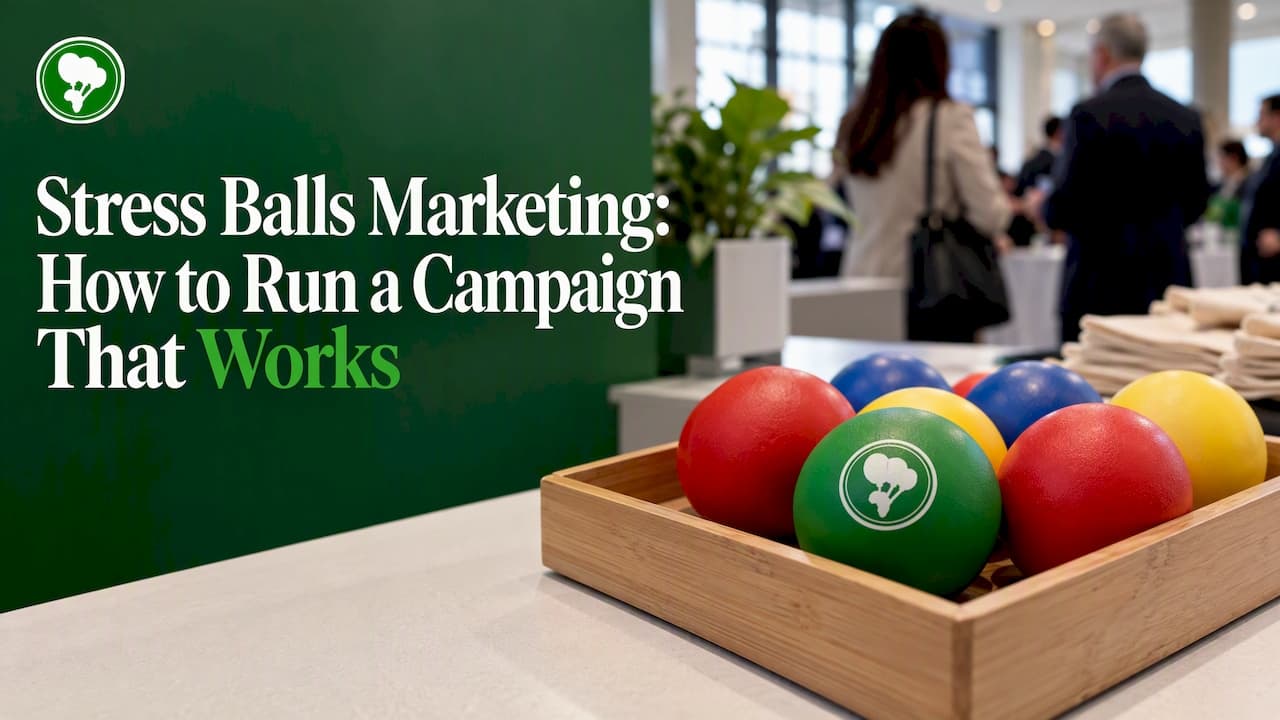
Branded stress balls work in marketing because people keep them, squeeze them and leave them on the desk where your logo stays in view. They work best when the shape fits your business, the logo is clear, and you hand them over in person rather than dumping a box on a table. Below you'll find the evidence, the audiences that suit them, the design choices that matter and the South African checks to make before you order.
Key takeaways
- Stress balls rank among the most purchased promotional products by volume worldwide, according to market research on the category.
- The same research puts average lifetime exposure at about 840 impressions per ball, which makes the cost per impression competitive with traditional advertising.
- Shape, a legible logo and a deliberate hand-out moment matter more than the size of the order.
- Education, agencies, hospitality, professional services and finance are the strongest promo buyers in South Africa, so match the giveaway to a real audience.
- Check labelling, lead time and the order quantity before you commit to artwork.
Table of Contents
- Why stress balls earn their place in a marketing budget
- What the recall research says
- Who should receive stress balls
- Designing a stress ball people keep
- How to hand them out
- South African checks before you order
- Our view on stress balls in marketing
- Branded stress balls and balloons from Balloon & Printing
- FAQ
- Sources
Why stress balls earn their place in a marketing budget
Most promotional items are used once or twice. A stress ball is picked up many times a day, often during a tense call or a long meeting. That repeated contact is the whole case for it.
The numbers back this up. A Stress Ball Market Research Report says stress balls consistently sit among the top 10 promotional products by volume. It also estimates an average of 840 impressions over a ball's lifetime. Treat that as an industry estimate, not a promise: your own result depends on who gets the ball and where it ends up.
There is a second benefit. A stress ball is a wellness item as well as an advertisement, so it gives the receiver a reason to keep it. Brands that give something useful tend to be remembered more kindly than brands that hand over a flyer.

What the recall research says
The best-known recent figures come from Australia and New Zealand, not South Africa, so read them as a guide to how promotional products behave rather than a local benchmark.
- APPA's industry research for 2025 to 2026 found that 81% of recipients can recall the brand on merchandise they have received.
- In an APPA comparison of two studies, 77% of recipients said they bought from a brand after receiving a promotional item, and 66% visited the brand's website or social media after getting a physical gift.
The second finding is the one to build on. A physical item can send people to your digital channels, so put a short web address or a social handle on the ball and make sure the page it points to is ready.

Who should receive stress balls
Ask who sits at a desk, who faces deadlines and who attends events where you can speak to people.
In May 2025, ASI published its first study of South Africa's promotional products industry. It found that education is the top sector for generating promo business, followed by ad agencies, hospitality, professional services and financial or insurance companies. Globally, corporate offices were the largest application segment for stress balls, with a 41.3% revenue share in 2025, driven by employee wellness programmes.
In practice, that points to a few strong uses:
- Exam-season and campus drives for schools, colleges and tutoring brands.
- Client gifts from accountants, attorneys, insurers and agencies, where the ball sits next to a keyboard.
- Staff wellness days and onboarding packs in corporate offices.
- Expo stands and career fairs, where a ball in the hand keeps people at your stand.
- Kids' meal promotions, where a fun shape such as a mascot or a food character gives children something to take home and keep.
For more ideas on what recipients actually keep, see our guide to corporate event giveaways.
Designing a stress ball people keep
A ball that looks cheap goes in the bin. A ball that suits the brand stays on the desk. Four decisions matter.
Shape
Choose a shape that ties to your industry or theme: a house for an estate agent, a tooth for a dental practice, a globe for a travel company, a burger or chip box for a restaurant. A round ball is the safe default when the logo is the star. A themed shape does the talking for you and is more likely to be shared.
Material and feel
Pick the material for the texture and resistance you want. A softer ball suits children and a firmer one suits an office. Squeeze a sample first if you can.
Logo and colour
Use a high-resolution file, your consistent brand colours and a clearly visible logo. Keep the artwork simple: one logo, one short line, one web address. Crowded print is unreadable on a curved surface.
Quantity
Minimum orders have fallen as suppliers adopt flexible production. The 2034 market report says small businesses can now buy as few as 25 to 50 units of custom stress balls. Confirm the exact minimum with whoever prints yours, because it varies by shape and supplier. If you also order printed balloons for the same campaign, our note on choosing 10, 20 or 100 packs helps you avoid overbuying.

How to hand them out
A ball left in a pile gets taken by people who don't care and ignored by people who do. Hand-out moments beat drops.
- Give them with a conversation. At an expo or a staff wellness check-in, hand the ball over while you speak. The interaction is what makes the gift feel considered.
- Give them with a next step. For internal programmes, pair the ball with a route to real support, such as your employee assistance programme or a counsellor's contact details. A stress ball is a small comfort, not a substitute for help.
- Include them in a pack. Slot a ball into a client welcome kit or a goodie bag with a card that tells the person why they received it.
- Give them at the right time. Hand them out before exams, at year-end, during tax or audit season, or at an event where people are standing for hours.
- Track the result. Use a unique web address or a discount code on the ball so you can see who responded.
If the ball is part of a larger activation, our guide to planning a brand activation with balloons shows how to link the items into one campaign.
South African checks before you order
- Labelling. If your item is sold or distributed as a prepackaged product, SANS 289:2022 sets labelling requirements, including identity, manufacturer or distributor details and net quantity. Ask your supplier whether your packaging needs them.
- Safety for children. If children will receive the item, ask for the supplier's safety certification and confirm it applies to that specific product.
- Lead time. Artwork approval takes time. Our note on balloon printing lead time explains how artwork can add 1 to 4 days, and the same discipline applies to any printed item: send final artwork early.
- Delivery. Confirm the delivery address, the date of your event and who signs for the parcel before you pay.
Our view on stress balls in marketing
We make branded balloons, stress balls and shakers every week, and the same mistake keeps appearing: brands treat the giveaway as the campaign. It isn't. The giveaway is the reminder, and the campaign is what you do with it.
Our advice is to pick one audience, one message and one hand-out moment. Put the logo where it can be read from a metre away. Keep the item useful, and make it fun. A child who gets a bright, soft shape at a restaurant will carry it around for weeks, and a manager who gets a clean, well-printed ball will keep it on the desk.
We also think sustainability counts. Our latex balloons come from rubber tree sap and are 100% natural and biodegradable, certified to EN71, and we bring the same quality focus to our other branded items. When a client runs balloons and stress balls together, the campaign feels like one idea rather than two purchases.
— Richard
Branded stress balls and balloons from Balloon & Printing
We supply branded promotional balloons, stress balls and shakers, custom inflatables and event décor through a national network of decor teams. Browse the full range on our products page, or visit our home page to see our biodegradable latex balloons in over 50 colours. Tell us your audience and your event date, and we'll help you match the item to the occasion.
FAQ
Are stress balls a good promotional product?
Yes, for the right audience. They rank among the most purchased promotional products by volume, and they are used repeatedly, which keeps your logo in view. They work best for offices, schools and events, and for clients who sit at a desk.
How many stress balls should I order?
Start with the number of people you can actually reach with a conversation or a pack. Market research says small businesses can now order from around 25 to 50 units, though the minimum depends on the shape and supplier. Ask for a quote on two quantities and compare the unit cost.
What should I print on a stress ball?
Your logo, in your brand colours, plus one short line such as a web address or social handle. Keep it simple, because the surface is curved and small. Use a high-resolution file so the edges stay sharp.
Can stress balls replace digital marketing?
No, and they shouldn't. Research from APPA describes branded merchandise and digital marketing as complementary, with physical items often sending people to a brand's digital channels. Use the ball to start the connection and your website to finish it.
Sources
- Stress Ball Market Research Report 2034
- APPA Industry Research 2025-2026
- Two Studies, One Clear Picture: What the Promotional Products Industry Looks Like in 2025
- ASI research on South Africa's promotional products industry, May 2025
- SANS 289:2022 (Ed. 2.00)