
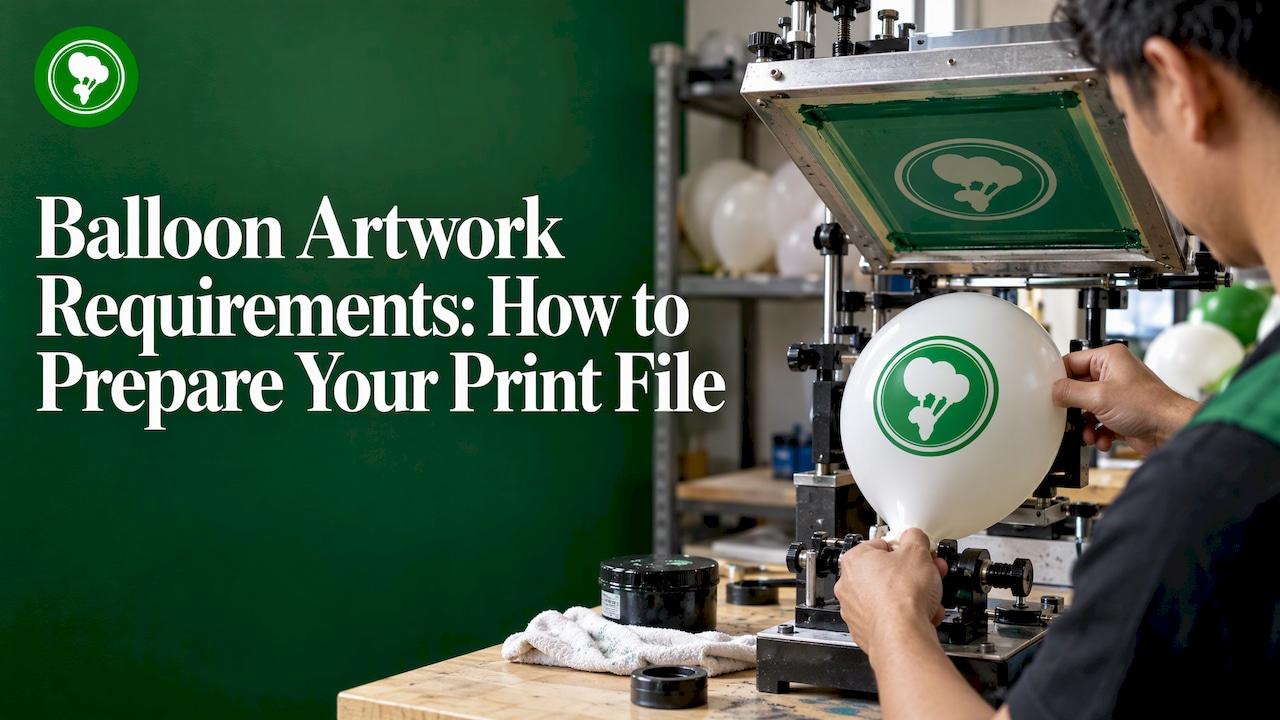
Balloon artwork has to be simple, bold and sized to the printable area of the balloon, not to the balloon's inflated diameter. Use a vector logo, strong contrast, a short message and as few colours as you can. Then get the printer's template and confirm the print area before you finalise anything. The rest of this guide shows how to do that for latex and foil balloons.
Key Takeaways
- The printable area is much smaller than the inflated balloon, and it differs between latex, foil and giant balloons.
- Bold, high-contrast, short-message artwork reads best. Fine detail, thin lines and tiny type are the usual failures.
- Send vector artwork with text converted to outlines, and use the colours you actually want printed, not screen-only RGB brights.
- Always work from your printer's own template and sizes, and ask for a proof when the order is large or the colours are critical.
Table of Contents
- Why a balloon is not a flat canvas
- How big is the printable area?
- Designing a logo or message that stays legible
- File format, resolution and colour setup
- Latex or foil: how the artwork choice changes
- Checklist before you send artwork
- Our perspective
- Ready to order printed balloons?
- FAQ
- Sources
Why a balloon is not a flat canvas
A balloon is printed while it is flat or lightly stretched, then inflated. The image grows with the rubber, and it distorts as it does. That is why the inflated size of a balloon tells you very little about the artwork area.
One published guide on preparing large-format balloon artwork makes the same point: there is no universal "large balloon" canvas, and the usable imprint is limited by curvature, seams, taper and the printing equipment. A 30 cm latex balloon, a 100 cm giant balloon and a foil helium balloon can all have very different print areas.
In practice this means one rule: never design first and ask about size later.

How big is the printable area?
The same guide reports approximate figures from printers elsewhere: roughly a 16 cm circular imprint on latex balloons and about 22 cm on foil balloons. It also gives examples of about 15 x 15 cm on a 30 cm latex balloon, 40 x 40 cm on a 60 cm giant balloon and 50 x 50 cm on a 100 cm giant balloon. Treat these as ballpark figures only. Your own printer's template is the number that counts, because it depends on the balloon, the machine and the print method.
| Balloon type | Approximate print area (from published examples) | What it suits |
|---|---|---|
| Standard latex | Around 15 to 16 cm across | Logo plus a short line |
| Foil | Around 22 cm across | Slightly more detailed logos |
| 60 cm giant | About 40 x 40 cm | Bold brand marks, event names |
| 100 cm giant | About 50 x 50 cm | Large single-message graphics |
You can check the sizes we work with on our balloon sizes page, and the different methods that sit behind these limits are explained in our guide to balloon printing methods.
Designing a logo or message that stays legible
Think of the balloon as a small billboard seen from across a room. These habits keep a design readable once it is inflated:
- Lead with one idea. A logo and one short line, such as a name, a date or a web address. Paragraphs of copy will not survive.
- Choose contrast over cleverness. A dark ink on a light balloon, or a white or light ink on a deep balloon colour, will carry further than two similar mid-tones.
- Thicken fine strokes. Hairlines, delicate script fonts and tiny taglines can fill in or break up as the latex stretches. Choose a heavier weight of your typeface, or simplify the logo for balloons.
- Keep to the middle. Leave generous space between the artwork and the edge of the imprint area so that distortion and slight shifts do not clip anything.
- Cut the gradients. Soft shadows, photographs and subtle tints rarely reproduce well on rubber. Flat, solid colour shapes do.
If you are planning a product launch or a campaign, our notes on launch balloons and brand visibility with balloons show how these rules work in real setups.

File format, resolution and colour setup
The exact specification comes from your printer, but a sensible starting point is the same for most balloon work:
- Vector first. Send your logo as a vector file (AI, EPS, SVG or a vector PDF). It scales to any imprint size without softening.
- Outline your text. Convert fonts to outlines or curves so that nothing is substituted when the file opens elsewhere.
- Remove what should not print. Delete backgrounds, guides and any stray boxes. Anything left in the file may be treated as artwork.
- Reduce the colour count. Spot-colour printing is typically priced and set up per colour, so a one- or two-colour logo is usually the most practical choice. One published guide notes that some printers handle up to eight spot colours on latex and up to six on foil, as well as full CMYK. Ask what yours supports.
- Mind the screen-to-ink shift. The same guide warns that bright RGB colours, especially neon-like greens, blues and oranges, can change when converted to printable inks. The same ink can also look different on coloured latex, white latex and metallic foil.
Because the balloon colour itself changes how an ink looks, choose the balloon first. Our balloon colours page shows the range, and the article on colour combinations helps with pairing ink and balloon.
If you are producing signage or printed collateral to match your balloons, the finish matters too. This explanation of matte vs gloss lamination helps you keep the look consistent across materials.
Latex or foil: how the artwork choice changes
Latex balloons stretch and the print stretches with them, so keep designs simple and centred. Foil balloons are flat and do not stretch in the same way, which generally allows a little more detail in a slightly larger area. Foil also has a metallic or coloured surface that affects how ink appears. We compare the two in more depth in our article on foil vs latex balloons.

Checklist before you send artwork
Run through these questions with your printer before the file goes into production:
- Which balloon material, inflated size and colour are you printing on?
- What are the printable width and height, and is there a template?
- Which print process is used, and how many colours are supported?
- What are the minimum line width, gap between elements and type size?
- What bleed, trim and safe-area rules apply?
- What file format and colour profile should you supply?
- Can you see a proof or sample, if the size, colour or fine detail makes a mistake expensive?
Do this early. Artwork approval is one of the steps that affects timing, and our piece on balloon printing lead time explains how it fits into an event schedule.
Our perspective
Most artwork problems we see are not about talent. They are about a design made for a screen being squeezed onto a curved, stretching surface.
Our approach is to start from the balloon: choose the size and colour from our range of more than 50 colours, then build a bold, simple design to suit. Our balloons are made from natural rubber tree sap, are biodegradable and are certified to EN71, so we want the print to be as good as the balloon it sits on.
Whether it is a corporate function, a wedding, a promotion or a kiddies menu giveaway at a restaurant, the best-performing designs are usually the simplest ones: one logo, one message, strong contrast.
Richard CEO
Ready to order printed balloons?
We supply branded promotional balloons in biodegradable latex, together with stress balls, shakers, inflatables and event décor delivered nationwide. If you want plain colour balloons or foil to go with them, browse the shop or start from our home page.
FAQ
What file type is best for balloon artwork?
A vector file with text converted to outlines is the safest choice, because it scales cleanly to any print area. Confirm the exact formats your printer accepts before you send the file.
How many colours can I print on a balloon?
It depends on the printer and the process. One published guide mentions up to eight spot colours on latex and six on foil at some printers. A one- or two-colour design is usually the most reliable and economical.
Can I print a photograph on a balloon?
Photographs and soft gradients rarely reproduce well on stretching latex. Bold, flat-colour graphics with strong contrast are the better choice. Ask your printer which processes suit more detailed images.
Why do printed colours look different from my screen?
Screens use RGB light, while balloons use ink. Bright neon-style colours in particular can shift in conversion, and the same ink looks different on coloured latex, white latex and foil. Pick your balloon colour first and ask for a proof when colour matters.