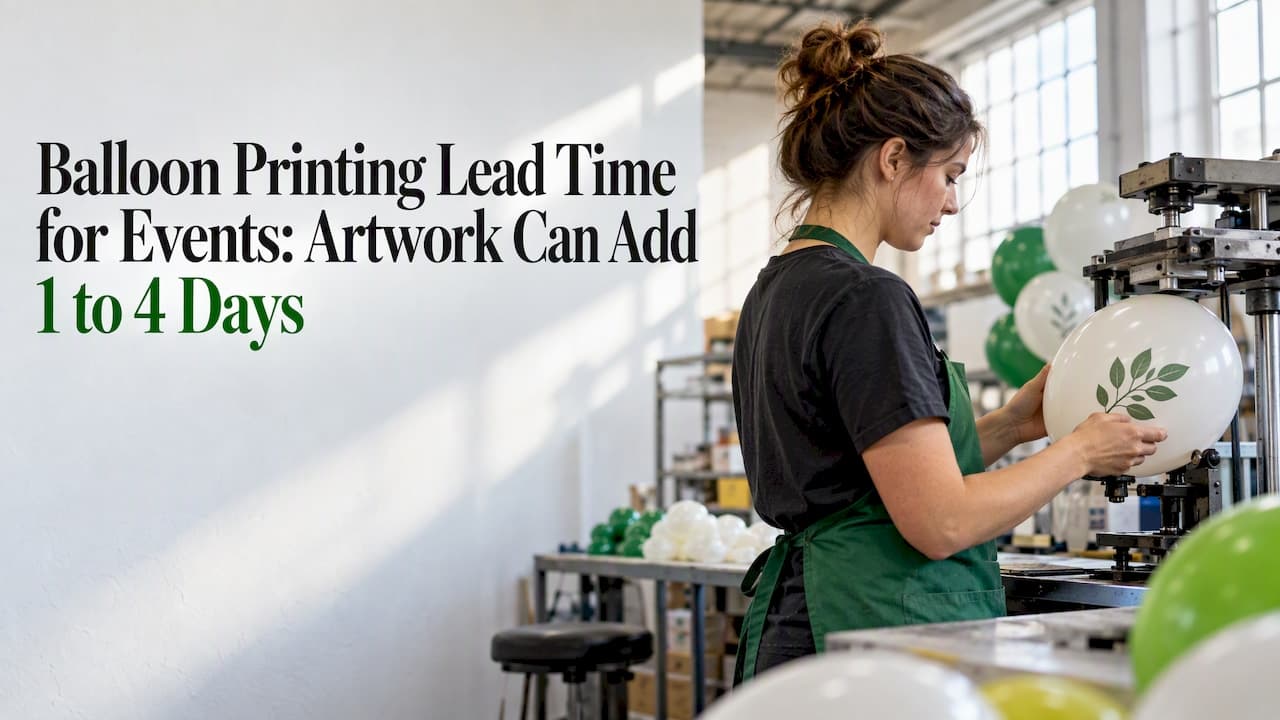
A typical custom balloon order needs production time, transit time, and a safety buffer, and small custom runs can often be ready within a week, while bulk or complex jobs take longer. The decisive factor isn't the printing itself: it's whether your supplier confirms artwork approval and dispatch dates against your actual event date, not just an estimated "turnaround".
TL;DR:
- Build the deadline backward from the event date by adding production and transit days, then include a buffer of at least three days.
- Artwork problems, including low resolution files or missing bleed, can add one to four days, while one approver can save two or three days.
- Rush processing can shorten some stages, but curing time and color availability still impose limits, so submit final artwork and confirm the deposit early.
- Outdoor or fixed date events need a larger buffer; during peak seasons, lock designs by week eight and submit artwork and deposit by week six.
Table of Contents
- Breaking down production time versus shipping time
- The hidden delays that push back your delivery date
- How to calculate your latest order date
- What our production schedule looks like in practice
- What experienced organisers do differently
- Request a rush quote or book your production slot
- FAQ
- Sources
Breaking down production time versus shipping time
Total lead time has two distinct phases, and conflating them is the most common planning mistake. Production covers everything that happens before a balloon leaves the workshop: artwork proofing, printing or setup, curing and quality checks, then packing. Transit covers everything after dispatch, and it varies enormously depending on courier choice and destination.
A realistic production breakdown looks like this:
- Artwork and proof approval: usually 1 to 2 days, longer if revisions are needed.
- Printing or setup: 1 to 3 days for standard digital runs, more for multi-colour or large-format work.
- Curing and quality assurance: typically 1 day, sometimes folded into printing time.
- Packing and dispatch preparation: usually under a day for most order sizes.
Small digital runs with simple one or two colour designs tend to clear production fastest. Custom-printed latex balloons with multiple colours or intricate artwork take longer because each colour pass adds setup time. Large bespoke inflatables or decor installations sit at the far end, often needing more design iteration before manufacturing starts at all.
Transit then adds its own variable. A local same-day or next-day courier is fastest but limited to shorter distances. Domestic multi-day shipping is the default for most orders and typically adds several days depending on the service level chosen. According to production and shipping guidance, total lead time is simply production days plus transit days, with a buffer added on top for safety.

The hidden delays that push back your delivery date
Most lead time overruns don't come from printing itself: they come from the steps around it. Knowing where delays hide lets you prevent them rather than react to them.
- Artwork faults: wrong file type, low resolution or missing bleed are the most frequent causes of proofing delays, and fixing them typically adds one to four extra days depending on how many revision rounds are needed.
- Stock shortages: unusual colours or specialist finishes can be out of stock, pushing production back until new material arrives.
- Approval delays: when sign-off sits with multiple stakeholders, each review cycle can cost a full day or more.
- Seasonal queueing: peak periods such as graduation season or the December holidays push jobs further back in the production queue.
Structuring your side of the process prevents most of these. Submit final, print-ready artwork the first time, and nominate a single approver rather than a committee.
Pro Tip: Send your final artwork and get one person to approve it, rather than circulating proofs for group sign-off: this alone can save two or three days.
How to calculate your latest order date
A simple formula turns abstract day ranges into an actual calendar cut-off: total lead time = production days + transit days + buffer days. Once you know your event date, you count backwards from it to find the latest date you can safely place your order.
- Estimate production days based on order complexity: small simple runs sit at the short end, multi-colour or bulk orders at the longer end.
- Add transit days based on your chosen courier and whether delivery is local, domestic or international.
- Add a buffer, with a three-day buffer recommended as a practical minimum for any event-critical order.
- Subtract the total from your event date to find your latest safe order date.
Two worked examples, using illustrative figures only, show how this plays out. Say a small corporate order needs 3 production days and 2 transit days: adding a 3-day buffer gives 8 days total, meaning an order for an event on day 20 of the month should go in no later than day 12. Say a larger bespoke order needs 6 production days and 4 transit days: with the same 3-day buffer, that's 13 days total, meaning the order needs to be placed roughly two weeks ahead.
Outdoor events or anything with a fixed, non-movable date deserve a larger buffer than indoor or flexible bookings, since weather delays, venue access issues or last-minute courier problems have no slack to absorb.

What our production schedule looks like in practice
Our balloons are made from biodegradable latex sourced sustainably and come in a wide range of colours, with quality checks conducted before shipping. Those checks add a quality-control step to the schedule, but they're there to make sure every balloon is safe for the event it's heading to.
A typical order moves through our process like this:
- Deposit and artwork submission: confirms your slot in the production queue and starts the proofing clock.
- Proofing and approval: we check files and confirm colours and sizing before anything is printed.
- Printing and curing: standard runs move through this stage within a few working days.
- Dispatch and delivery confirmation: we confirm your delivery window once the order leaves our workshop.
EN71 certification is a supplier-side quality step that applies across our production ranges, and it's one of the reasons organisers booking corporate or wedding orders choose to confirm their production slot early rather than leaving it to the last minute.
Rush options can compress some of these stages, but express processing has real limits: colour availability and curing time can't be skipped entirely, even on priority jobs. Confirming your deposit and submitting final artwork as early as possible is the single biggest lever you have over your own timeline.
What experienced organisers do differently
The organisers who never scramble follow one habit: they keep core stock of standard sizes and colours on hand, then place custom-printed orders on deposit as soon as a design is locked. That way, a delay in one layer doesn't stall the whole event.
In the final eight weeks before an event, lock your design and colours by week eight, submit final artwork and pay your deposit by week six, confirm proofs by week five, and leave the final two weeks purely for transit and buffer. Peak seasons compress all of this, so a last-minute order in a busy month carries real risk of missing your date.
— Richard
Request a rush quote or book your production slot
We produce biodegradable latex balloons in a wide range of colours, with quality checks and decor teams ready to support corporate functions, weddings and promotional events. If your event date is close, the fastest path is a direct conversation about your production slot rather than guessing at generic turnaround times.

- Send your quantities, colours and artwork specs to get an accurate production estimate.
- Confirm your deposit and final artwork early to lock in your preferred dispatch window.
- Browse our biodegradable latex balloon range or the full product catalogue to check what's available for your event.
When you need a quote turned around fast, a tight, complete brief helps: one partner example worth borrowing from is a concise quote-request format that lists exactly what details to send to get pricing back within one to two business days.
FAQ
How long does custom balloon printing usually take?
Small custom runs with simple designs typically clear production within a few working days, while larger or multi-colour orders take longer. Total lead time is production time plus transit time plus a buffer, so the honest answer depends on your order size and delivery distance.
What causes most delays in balloon printing orders?
Artwork problems such as wrong file formats, low resolution or missing bleed are the most common cause, and fixing them can add one to four extra days. Stock shortages on specialist colours and slow internal approvals are the next most frequent causes.
How much buffer time should I add for an event deadline?
A minimum of three days is a practical starting point for any event-critical order, and outdoor or fixed-date events deserve more. The buffer exists to absorb courier delays, weather or last-minute production hiccups without threatening your event date.
Does order quantity affect how long printing takes?
Yes, larger bulk orders generally need more production days than small runs because printing and curing scale with volume. Complex designs with several colours or intricate artwork also extend production time regardless of quantity.
Can rush or express balloon printing shorten the timeline?
Express processing can compress some production steps, but material curing time and colour availability still set a practical floor on how fast an order can move. Confirming your deposit and submitting final artwork immediately remains the most reliable way to protect a tight deadline.