
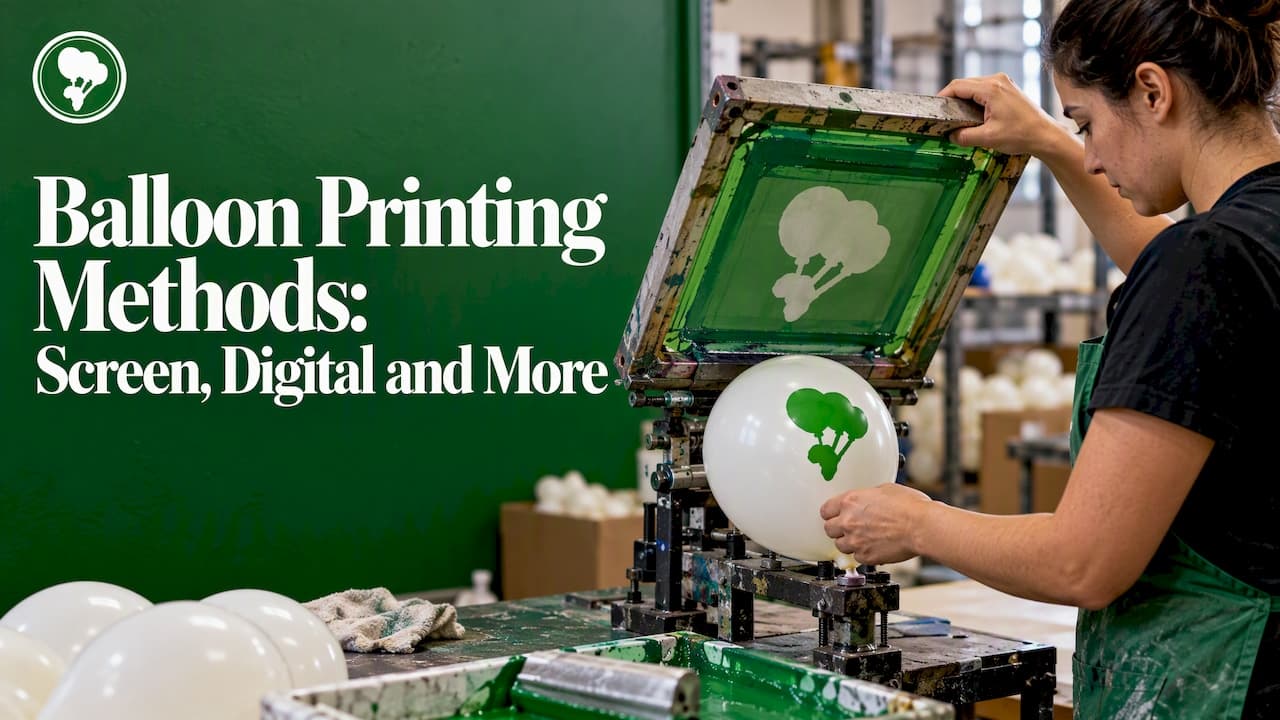
There are two main ways to print on a balloon. Screen printing pushes ink through a stencil and suits bold, simple logos on latex in bulk. Digital printing jets ink straight from a file and suits short runs, fine detail and photo-style artwork, mostly on foil. Which one is right depends on the balloon material, how many colours your design has and how many balloons you need.
Key takeaways
- Screen printing is the standard for branded latex balloons: one or two solid colours, large quantities, sharp results.
- Digital UV printing handles detail, gradients and photos, and is better for small batches, mostly on foil.
- Latex stretches, foil does not, so the material often decides the method before you do.
- Simple artwork, supplied as vector files, prints cleanest and avoids delays.
- Ask about colour count, print position and lead time before you commit to a quantity.
Table of Contents
- The main ways to print on a balloon
- How screen printing on balloons works
- How digital balloon printing works
- Latex or foil: the material decides a lot
- What affects quality, cost and turnaround
- How to choose a method
- Our view on printing on balloons
- Printed balloons from Balloon and Printing
- FAQ
- Sources
The main ways to print on a balloon
A balloon is a curved, elastic surface, so printing on one is not like printing on paper. The ink has to grip rubber, survive stretching and dry without sticking balloons together. That is why a handful of methods dominate.
| Method | Best for | Typical design | Quantity |
|---|---|---|---|
| Screen printing | Latex balloons | Logos, text, 1 to 2 solid colours | Medium to large runs |
| Digital UV printing | Foil and flat surfaces | Photos, gradients, fine detail | Short runs |
| Wrap-around printing | Latex balloons | Design that circles the balloon | Medium to large runs |
In the printing trade generally, digital printing goes from file to press with minimal setup, while screen printing is economical for bulk work because each solid colour needs its own screen. Those are general printing principles, but they carry over directly to balloons: setup effort is spread across the run, so volume lowers the cost per balloon.
How screen printing on balloons works
Screen printing is the method behind most branded latex balloons you see at launches, school events and shopping centre promotions.
- Your artwork is turned into a stencil on a fine mesh screen, one screen per colour.
- The balloon is inflated slightly so the surface is taut.
- Ink is pushed through the screen onto the rubber with a squeegee.
- The balloon is dried and removed before the next colour or the next balloon.
The industrial version of this is described in a US patent for balloon screen-printing apparatus, which lays out inflation, sequential colour printing, drying and removal stations. Printing the balloon while it holds a little air gives the surface the tension the ink needs to transfer evenly.
What screen printing suits
- Company logos and slogans in one or two colours
- Event names, dates and simple messages
- Large orders for giveaways, kids' meal promotions or brand activations
- Designs that need strong contrast, such as white ink on a dark balloon
The limits follow from the process. Every extra colour means another screen and another pass, so the cost and the registration difficulty both climb. Fine hairlines, tiny text and smooth gradients do not reproduce well on a stretchy, rounded surface.
One side, two sides or wrap-around
You can usually choose one print position, a print on both sides, or a wrap-around design that circles the balloon so it is visible from every angle. Wrap-around is useful when balloons will be tied to chairs or arches and viewed from all sides. It needs more careful artwork placement, so allow for it when you brief your supplier.

How digital balloon printing works
Digital printing skips the stencil. Your file goes to a printer that jets ink onto the surface. According to a 1 September 2026 guide from a printer manufacturer, UV digital printing suits short runs and detailed or photo-style designs, while screen printing suits high-volume, simple latex designs.
That matches how the trade splits the work in practice:
- Foil balloons start out flat, which makes them far easier to feed through a flat-bed digital printer. They are also the natural home for full-colour artwork, such as a photo, a detailed mascot or a multi-colour pattern.
- Latex balloons can be printed digitally in some set-ups, but the stretch and curve make it harder, and it is rarely the economical choice for large quantities.
If you are weighing setup cost against print quality in general, this comparison of digital versus flexo printing explains the same trade-off in another packaging context: digital wins on flexibility for small runs, plate-based methods win as volumes grow.
Latex or foil: the material decides a lot
Latex is stretchy, comes in a wide colour range and is the usual choice for branded giveaways and décor. Foil is a metallic film, holds its shape, floats longer with helium and takes detailed digital artwork well. If you are still deciding between them for the event itself, our comparison of foil and latex balloons for events covers durability and finish.
Two points matter for printing:
- Balloon colour changes the ink colour. Light inks on dark balloons look weak. White, gold, silver and black inks on mid and dark balloons give the strongest contrast. A pale balloon with a dark ink is the safest combination for legibility.
- Print area is limited. The visible, flat part of an inflated balloon is smaller than the balloon itself, so large logos and long taglines get distorted.

What affects quality, cost and turnaround
Five things shape what you get and what you pay:
- Number of colours. In screen printing each solid colour adds a screen and a pass.
- Quantity. Setup is a fixed effort, so unit cost drops as the run grows.
- Artwork quality. Vector files (such as AI, EPS or PDF with outlined text) reproduce crisply. Low-resolution images pulled from a website do not.
- Balloon size and colour. Bigger balloons give more room, but inflation level changes how the print looks.
- Drying time. Inks need time to cure before balloons are packed, which is part of the lead time.
Artwork approval is the step that surprises people most. We cover it in balloon printing lead time for events, where artwork changes can add one to four days before production even starts.
How to choose a method
Work through these questions in order:
- What material? Latex points to screen printing, foil to digital.
- How many colours? One or two: screen. A photo or gradient: digital, probably on foil.
- How many balloons? Hundreds or thousands: screen. A few dozen: digital, or a simple screen print if the design is basic.
- Where will they be seen? Hung in a room, held by children, tied to a stand? That decides one-sided or wrap-around.
- When is the event? Work backwards from the date and add time for proofing, printing, drying and delivery.
A fast food restaurant adding balloons to a kids' menu, for example, usually wants a single-colour logo on bright latex in large quantities. That is a screen printing job. A one-off anniversary with a couple's photo is a digital job on foil.
Our view on printing on balloons
We make our balloons from sustainable rubber tree sap, so the first thing we ask about any print job is what the balloon is made of and what happens to it afterwards. Our latex balloons are 100% natural and biodegradable and certified to EN71, and we would rather you choose a simple, bold print that works than a complicated one that looks muddy once the balloon is inflated.
Our advice is consistent: keep to one or two colours, give the logo room, pick a balloon colour that contrasts with the ink, and leave time for proofing. Printed balloons earn their keep when people can read them from across a room. If you are planning a wider campaign, our guide to brand activation balloons shows how printed balloons fit into it.
— Richard
Printed balloons from Balloon and Printing
We supply branded promotional balloons for businesses, event planners and private celebrations across South Africa, with more than 50 colours to match your brand. You can see the full range, including stress balls, shakers and inflatables, on our products page, or browse foil and latex balloons to buy on our shop page. For a printed order, send your logo and quantity and we will advise on the right approach.
FAQ
Can you print on a balloon at home?
Yes, for a handful of balloons. Home set-ups usually print on flat foil or on white balloons laid on a printer bed, and results depend on the printer and ink. For anything branded or in quantity, a screen printing supplier gives a far more consistent result.
Is screen printed balloon artwork limited to one colour?
No, but each colour needs its own screen, so most promotional jobs use one or two. More colours cost more and need tighter alignment. For full-colour artwork, digital printing is the usual answer.
Does printing affect whether a balloon is biodegradable?
The balloon itself is natural latex, but the ink is a separate matter. If sustainability matters to your brand, ask your supplier about the inks used before you order.
How long does balloon printing take?
It depends on quantity, colours and how quickly your artwork is approved. Proofing and drying are the stages people forget, so ask for a production date before you set your event date.
Sources
- The 12 Printing Methods Ranked by Cost, Speed, and Quality (Printulu)
- US Patent 6,050,182: Inflatable balloon color printing process
- Balloon Printer: How to Print on Balloon at Home (EufyMake)
- Digital vs Flexo Printing for Custom Food Packaging