
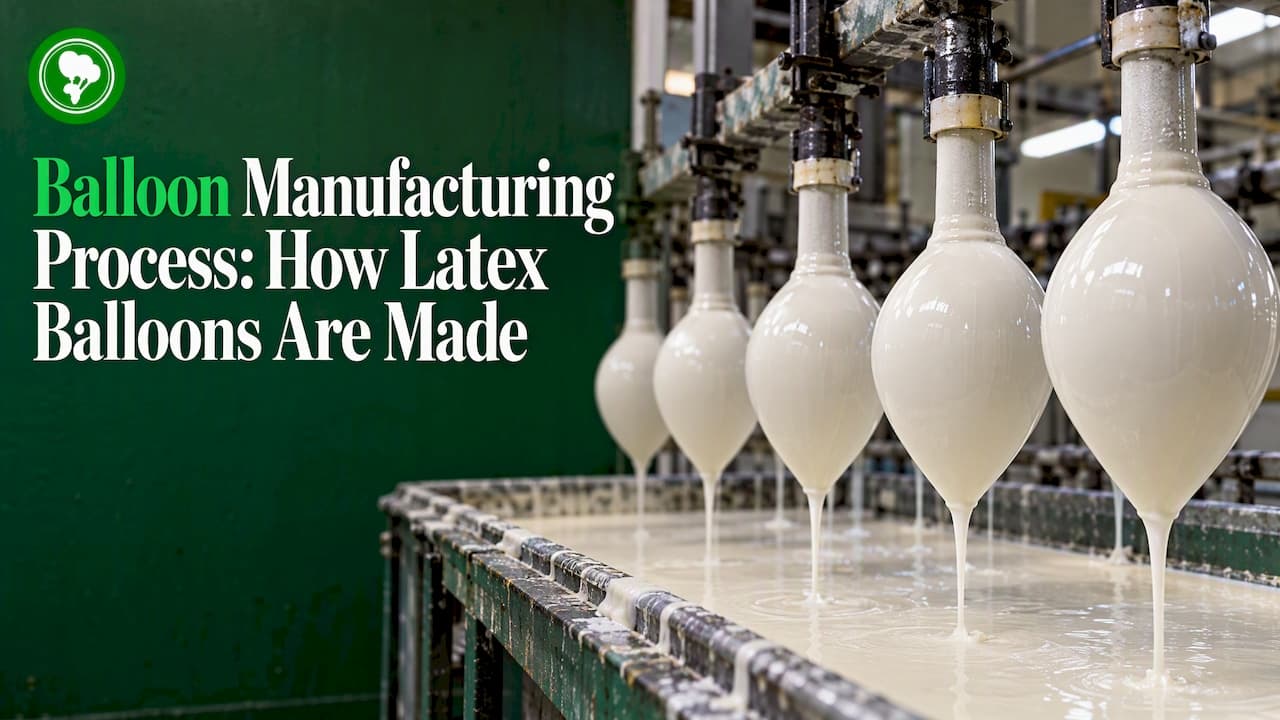
A latex balloon is made by dipping a clean ceramic or metal mould into liquid rubber, drying the thin film, rolling a lip at the neck, washing it, curing it in an oven and peeling it off. Colour comes from pigment mixed into the latex, and printing happens on the finished balloon. Foil balloons are a different product: sealed plastic sheets, not dipped rubber. Below is each stage in order, what quality checks matter, and what the process means for people with latex allergy.
Key Takeaways
- Latex balloons are dipped, not blown or moulded: a former is dipped in compounded latex, and the film is dried, beaded, washed, cured and stripped.
- The latex starts as sap tapped from rubber trees, so a natural latex balloon is a plant-based product, though added chemicals vary by maker.
- Washing (leaching) and curing decide how clean, strong and consistent a balloon is.
- Foil balloons are made from sealed sheets of film, which is why they do not behave like latex.
- Latex allergy is real: people who react should avoid latex balloons and speak to a doctor.
Table of Contents
- Where the latex comes from
- Step by step: how latex balloons are made
- How balloons are printed
- How foil balloons differ
- Latex allergy and balloons
- Our perspective
- Order balloons made for your event or brand
- FAQ
- Sources
Where the latex comes from
Natural rubber latex is the milky sap of the rubber tree. It is tapped, stabilised and concentrated before it reaches a balloon factory. The Sri Lanka Rubber Research Institute's guide to balloon manufacture describes balloons as dipped products, made in the same family of process as gloves and teats, using concentrated latex of 60% and above.
Because the raw material is tree sap, the balloon is a natural-rubber product. That is the basis of the biodegradable claim we make about our own range, which uses latex from sustainable rubber tree sap. How fast any balloon breaks down still depends on conditions, and we cover that honestly in our guide on why "biodegradable" can mislead for foil and latex balloons.

Step by step: how latex balloons are made
The process flow in the Sri Lankan guide runs through compounding, maturation, coagulant dip, drying, dipping, drying again, beading, leaching, vulcanisation, stripping, quality control and packing. Here is what each stage does.

1. Compounding and colour
Concentrated latex is mixed with curing agents, stabilisers and fillers, ground in a ball, pearl or colloid mill so they disperse evenly. Pigment goes in at this stage, which is why the colour runs through the whole rubber wall rather than sitting on the surface. A wide palette, such as the 50-plus colours we offer, is simply many separate batches of compounded latex.
The compound is then left to mature for a period before use, so that it dips consistently.
2. Dipping the former
The former is the balloon-shaped mould. It is cleaned and dried, then dipped into a coagulant solution that makes latex gel on contact. The Sri Lankan guide explains that a clean, dry former is immersed in the latex compound and withdrawn carefully so that a uniform layer is deposited. The time the former stays in the bath, and the stability of the latex against the coagulant, set the thickness of the wall. More dips mean a thicker deposit.
This is where the balloon's shape is decided. Round, long modelling and heart-shaped balloons all come from differently shaped formers.
3. Drying and forming the bead
The wet deposit is dried below 100°C first, so the water leaves without blistering the film. Next comes the bead, the rolled lip around the neck that lets you grip the balloon and tie it. Brushes roll the edge of the film into a ring. Without a firm bead, the neck tears when you inflate or knot it.

4. Leaching
The balloons, still on their formers, are washed in water. According to IntechOpen's chapter on natural rubber latex, this leaching removes residual chemicals and coagulant as well as naturally occurring latex proteins. It also describes an anti-tack treatment before bead formation so the rubber does not stick to itself. Good leaching is one reason a well-made balloon feels clean and dry, and why it matters for reactions to latex.
5. Curing (vulcanisation)
Raw rubber is weak and tears. Curing turns it into the stretchy, resilient material you know. The same chapter describes final drying and curing in an oven whose temperature rises gradually to about 90°C for roughly one hour. Heat links the rubber molecules together, which is what lets a balloon stretch several times its size and snap back.
6. Stripping
The cured balloons are lifted off the formers with compressed air or water. IntechOpen notes that water-stripped products need a final drying step. Many makers dust the balloons lightly so they do not stick together in the bag.
7. Quality control and packing
Balloons are inspected for pinholes, thin spots, uneven necks and colour consistency. The flow chart in the Sri Lanka Rubber Research Institute guide ends with quality control and packing. In practice, inflation tests on samples from each batch catch weak walls before they reach customers. For toys and children's products, a standard such as EN71 covers safety requirements. Ours are certified to EN71.
How balloons are printed
Printing is done after the balloon is made, on the inflated or stretched latex surface, using inks that stretch with the rubber. The method depends on run size, colours and the balloon shape. We explain the options in our guide to balloon printing methods, including screen and digital printing.
For a business, the practical point is this: a printed logo is applied to a finished balloon, so the base colour, balloon size and inflation level all affect how crisp the final print looks.
How foil balloons differ
Foil balloons are not dipped. They are cut from sheets of thin plastic film, usually with a metallic coating, and the edges are heat-sealed into a shape. They have a small valve or flap for inflation. Because the film does not stretch like rubber, foil balloons hold their shape, keep helium longer and cannot be tied into twists, and a popped foil balloon does not break down like natural rubber. Our guide to foil versus latex balloons for events goes into the trade-offs.
Latex allergy and balloons
Because balloons are natural rubber, they can trigger reactions in people who are latex-allergic. The Australasian Society of Clinical Immunology and Allergy says latex proteins and added chemicals can cause itching, hives and swelling of the lips, face or tongue after blowing up balloons, and that severe reactions can occur. It advises people with latex allergy to avoid latex, use substitutes, tell doctors and dentists in advance, and carry medical identification.
Johns Hopkins Medicine notes that exposure can happen when latex touches skin or mucous membranes, including while blowing up a balloon. DermNet adds that balloons are among products that can contain rubber accelerators, so a reaction may come from those chemicals rather than from the rubber proteins.
If you or a guest has a known latex allergy, or a reaction after handling balloons, see your doctor or an allergy specialist before choosing decor. For events, consider foil balloons or other non-latex decor, and keep latex balloons out of reach of anyone who is sensitive.
Our perspective
Most of what makes a balloon good happens before anyone sees it: the quality of the latex, how thoroughly it is washed and cured, and how consistent the colour is. That is why we build our range on 100% natural latex from sustainable rubber tree sap and certify it to EN71, rather than competing only on price.
We also see how the process shows up at events. A properly cured balloon inflates evenly, takes a print cleanly and holds its shape. Our customers include brands, event planners and families, and they all notice the same thing: a balloon that behaves well makes the whole setup easier. If you are planning decor, read how long latex balloons last before you decide on helium or air.
— Richard
Order balloons made for your event or brand
If you need biodegradable latex balloons in 50-plus colours, printed promotional balloons, stress balls, shakers or inflatables, see our full product range. You can order latex and foil balloons straight from our online shop, and our decor teams support corporate functions, weddings and promotions nationwide.
FAQ
How are latex balloons made?
A balloon-shaped mould is dipped into compounded natural latex, dried, given a rolled lip, washed, cured in an oven and stripped off. The result is a thin rubber film that stretches when inflated. Pigment in the latex gives it its colour.
How long does it take to make a latex balloon?
The exact time depends on the factory and the balloon size, so there is no single figure. The curing step alone takes about an hour according to IntechOpen, and the other stages add to that.
Are latex balloons safe for people with latex allergy?
No. Latex proteins and added chemicals can cause reactions, from itching and hives to severe reactions. Anyone with a known allergy should avoid latex balloons and ask their doctor about alternatives.
Are foil balloons made the same way?
No. Foil balloons are cut from plastic film and heat-sealed at the edges, while latex balloons are dipped and cured. That is why foil balloons keep their shape and latex ones stretch.
Sources
- Manufacture of Balloons, Sri Lanka Rubber Research Institute
- Natural Rubber Latex: Origin, Specification and Applications, IntechOpen
- Latex Allergy, Australasian Society of Clinical Immunology and Allergy
- Latex Allergy, Johns Hopkins Medicine
- Rubber accelerator contact allergy, DermNet