
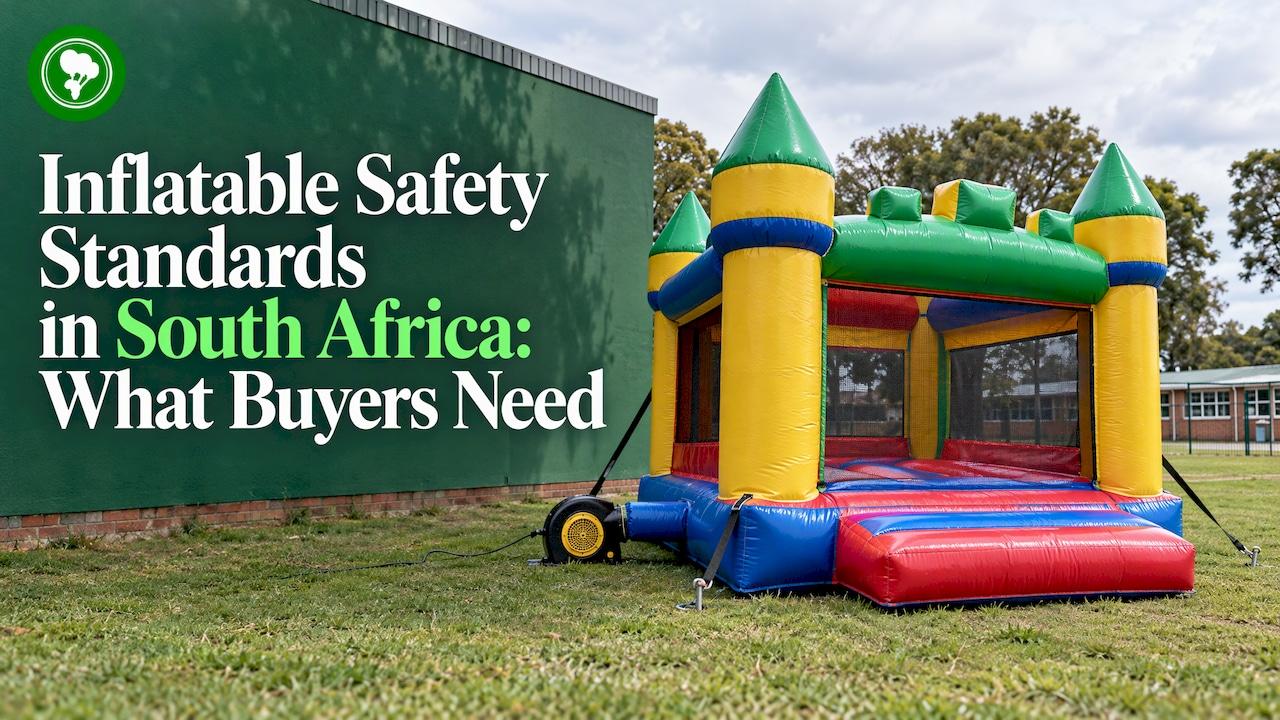
There is no single rulebook for "inflatables" in South Africa. Which standard applies depends on what the inflatable is. Large inflatables that children climb, bounce or slide on fall under SANS 54960. Toys, balloons and giveaways that children handle are judged against the EN 71 toy-safety series. Decorative and promotional inflatables sit between the two. Know which category you are buying, then ask the supplier for the matching proof.
Key Takeaways
- SANS 54960 is the South African standard for inflatable amusement and play equipment. Schools are told to get a compliance certificate before a large inflatable is used at a fun day.
- Balloons, stress balls and other items handed to children are toy-safety territory, where the EN 71 series is the reference.
- Anchoring is the safety point that matters most for any large inflatable, and wind limits apply everywhere.
- A promotional inflatable that nobody climbs on is a different risk from a bouncy castle, but it still needs anchoring and a sensible wind call.
- Ask for documents before you pay: a compliance certificate, a manual and test information.
Table of Contents
- Which standard applies to which inflatable
- What this means for promotional and decor buyers
- Anchoring: the rule that prevents the worst accidents
- Capacity, supervision and weather
- A short pre-purchase checklist
- Our perspective
- Put safe products behind your event
- FAQ
- Sources
Which standard applies to which inflatable
Play equipment you can climb on. According to school-governance guidance from FEDSAS, mobile amusement rides such as giant slides and other large inflatable play equipment fall under SANS 54960. The same guidance says the supplier or operator must provide a compliance certificate before the equipment is used at a school fun day or fundraiser. SANS 54960 is South Africa's inflatable amusement and play equipment standard, covering safety requirements and test methods.
What the standard looks at. It is the local counterpart of the European EN 14960 series. EN 14960-1:2019 covers materials, anchorage, structural integrity, access and exit, containment, entrapment, blower and electrical requirements, and the information a manufacturer must supply, including inspection and maintenance instructions. In short, it covers the whole product plus the paperwork that comes with it.

Events more broadly. SANS 10366 is a national standard based on the TPSA Event Safety Guide. According to the Southern African Communication Industries Association, it covers all aspects of event safety in South Africa. If you run a public event, your inflatables are one part of a larger safety plan.
Toys and items children handle. The EN 71 series tests toys for mechanical and physical hazards, flammability and chemical content. TÜV SÜD South Africa describes a voluntary "Safety tested" mark for toys based on the EN 71 series for products intended for children under 14. It combines product testing with periodic factory inspections.
A newer development concerns inflatable toys. SGS reports that EN 71-8:2026, published in January 2026, now includes inflatable activity toys, with requirements on blower position, anchorage for larger structures, a safe-collapse test and instructions. It is a European standard, so treat it as a direction of travel for the market rather than a South African legal requirement.
What this means for promotional and decor buyers
Most of our customers are not hiring jumping castles. They want printed balloons for a launch, stress balls for a brand activation, a blimp over a stand, or balloons on a kiddies meal. The practical split looks like this:
| What you are buying | Reference to ask about | What to request |
|---|---|---|
| Bouncy castle, slide, obstacle course | SANS 54960 | Compliance certificate, operator manual, blower details |
| Balloons and stress balls given to children | EN 71 series | Certification statement from the manufacturer |
| Display inflatables and blimps (nobody climbs them) | Manufacturer's instructions, event safety plan | Anchoring method, wind limit, inflation instructions |
| Event décor installed by a team | Your venue and event safety rules | Installation plan, who supervises |
If you are a restaurant adding balloons to a children's meal, the toy-safety question is the one that matters. Our balloons are made from sustainable rubber tree sap, are 100% natural and biodegradable, and are EN71 certified. Our guide to balloons for kids meals covers the safety and cost side for restaurants. Younger children and balloons need adult supervision, and our helium balloon safety guide sets out what parents and hosts should know.
If you are a manufacturer or brand producing your own finished toys, our 6-step EN71 compliance checklist walks through the process. For oversized product shapes at events, see four practical checks for inflatable product replicas.
Anchoring: the rule that prevents the worst accidents
In June 2025 two children were seriously injured in Krugersdorp when an unsecured jumping castle was lifted by a gust of wind at a school festival. An operator quoted by The Citizen said any inflatable with a roof or enclosed area must be anchored because it can behave like a parachute.
The principles hold for every large inflatable:
- Use every anchor point, every time.
- Check anchor loops and fixings for damage before each use.
- Do not set up on slopes or over sharp objects.
- Deflate and clear the unit when gusts start lifting its edges.
For reference, UK Health and Safety Executive guidance says no inflatable should be used in winds above 24 mph (38 km/h), that all anchor points must be used, and that wind should be measured at regular intervals and recorded. SafeWork SA in Australia requires operators to evacuate and deflate when gusts exceed the manufacturer's limit or 40 km/h, whichever is lower. These are foreign figures, not South African law. Their value is as a benchmark: whichever limit is lower, the manufacturer's instruction is the one to follow on the day.

Capacity, supervision and weather
For play inflatables, the same UK guidance says to limit users to the number in the manual or on the unit label, keep users within the height limit, separate bigger users from smaller ones, ban shoes, glasses and sharp objects, and keep intoxicated people off. The US Consumer Product Safety Commission's bulletin recommends at least one operator for bounces and small slides under 15 feet, and two for larger slides, with a maximum recommended weight per passenger of 200 lb unless the manufacturer says otherwise.
Supervision applies to people as much as equipment. If your event involves children outdoors, a guide to child safety at outdoor camps sets out the questions organisers can put to suppliers about certificates and supervision, and those questions carry over to a fun day.
Electrical safety also matters. Blowers must be kept dry, and cables must be positioned so nobody trips on them. Rain, lightning or power loss means the inflatable is cleared.

A short pre-purchase checklist
Before you commit to any large inflatable or a batch of children's giveaways:
- Ask which standard the product was made and tested to, and for the paperwork.
- Ask for the instruction manual, including maximum users, wind limit and anchoring method.
- Confirm who supervises on the day and who makes the call to deflate.
- For giveaways, confirm the materials and the certification that covers them.
- Check that anything you add or change has not voided the manufacturer's approval. TÜV SÜD notes that unauthorised changes make a certificate invalid.
Our perspective
Most safety questions we hear are really about two things: what a child will put in their hands, and what a structure will do in the wind.
For the first, we make balloons from sustainable rubber tree sap, so they are 100% natural and biodegradable, and they are EN71 certified. That matters when the balloon ends up with a four-year-old at a restaurant table.
For the second, we back our customers with a national network of decor teams, so events, weddings and corporate functions are set up by people who do it for a living. Printed balloons, stress balls and inflatables then carry your brand with a clear, documented safety basis.
Safety and visibility work together. A promotion that parents trust is one they remember.
Richard CEO
Put safe products behind your event
If you need balloons in more than 50 colours, printed with your brand, plus stress balls, shakers, blimps and inflatables or décor teams for an event, our products page shows the full range. You can also see our balloon colours and sizes before you order.
FAQ
Is there a South African standard for bouncy castles?
Yes. SANS 54960 is South Africa's standard for inflatable amusement and play equipment, setting safety requirements and test methods. School-governance guidance says suppliers or operators should provide a compliance certificate before large inflatables are used at school events.
Do balloons need EN 71 certification?
EN 71 is the reference series for toy safety, covering mechanical, flammability and chemical aspects. Our balloons are EN71 certified, which is a sound basis when balloons are given to children, for example with a kiddies meal.
What wind speed is too strong for an inflatable?
Follow the manufacturer's limit first. As benchmarks, UK guidance sets 38 km/h as the ceiling for play inflatables, and South Australia's regulator requires evacuation at 40 km/h or the manufacturer's lower limit. Any lifting at the edges means deflate and clear the unit.
Who is responsible when something goes wrong at an event?
The organiser and operator share the duty of care, which is why documents, anchoring and supervision are settled before the day. For a specific event, check the requirements with your venue and a qualified safety professional.
Sources
- FEDSAS: Die Taak van die Beheerliggaam
- SIST EN 14960-1:2019 overview
- Southern African Communication Industries Association: Standards
- TÜV SÜD South Africa: certification mark for toys
- TÜV SÜD South Africa: certification mark for playground equipment
- SGS: EN 71-8:2026 published for activity toys
- The Citizen: children fall from airborne jumping castle
- UK HSE: bouncy castles and other play inflatables
- SafeWork SA: inflatable amusement devices
- US CPSC: amusement ride safety bulletin