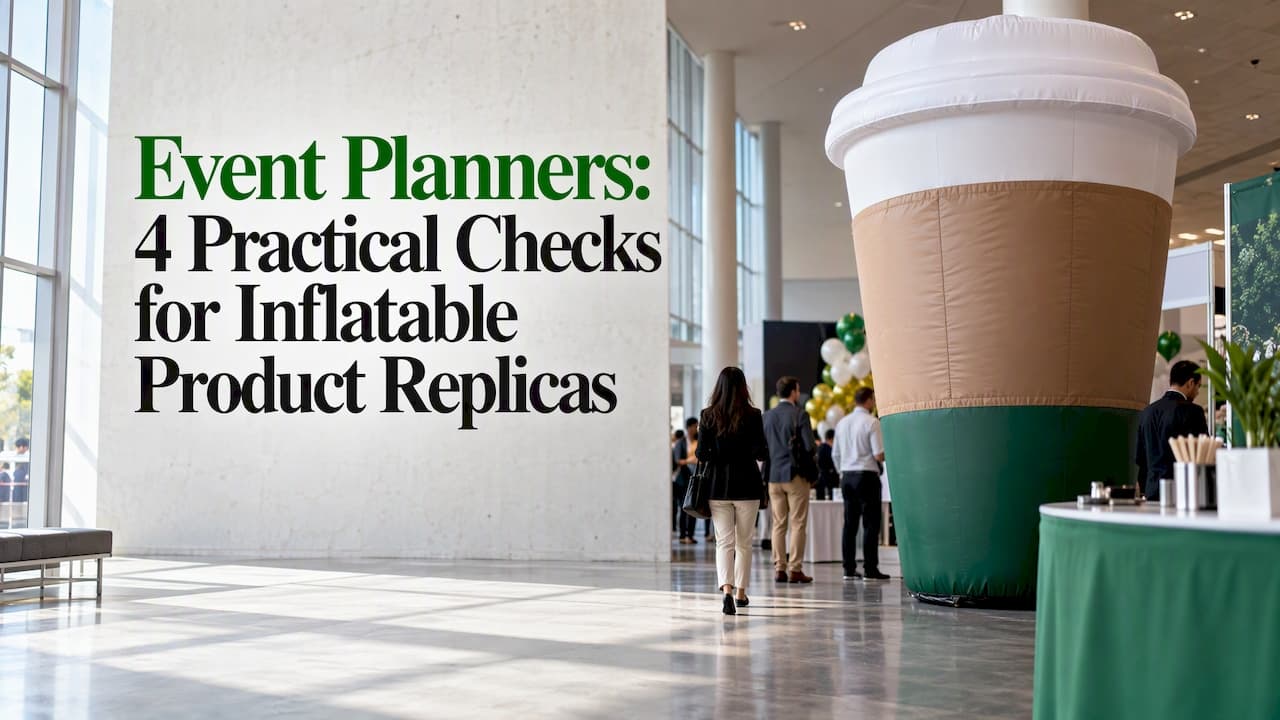
An inflatable product replica is a three-dimensional, oversized reproduction of a product or brand mascot built to grab attention at an event and give attendees a reason to stop, photograph and share. We see these used by experiential teams, brand marketers and event planners who need a focal point that flat signage simply cannot deliver. This article walks through design, materials, production, logistics and budgeting so you can brief one with confidence.
TL;DR:
- Inflatable replicas are most effective when scaled to fit sightlines, with silhouette design and signature features that ensure instant recognition from a distance.
- Durability relies on heavier fabric GSM, reinforced stress points, quality stitching, and weatherproofing, which are essential for outdoor use and long-term investment.
- Production timelines depend heavily on artwork approval and detailed briefs; supplying print-ready files early minimizes delays and rework risks.
- Proper sizing for transport and onsite logistics includes packed dimensions, wind ratings, continuous blower power, and appropriate anchoring methods, particularly outdoors.
- Reuse potential influences whether to rent or buy; buying is more economical for recurring events, while rentals suit one-time activations, with measurement tools like QR codes for ROI tracking.
Table of Contents
- Why inflatable replicas work for brands
- Design tips: how to make a recognisable, usable product replica
- Materials and construction: what to specify for durability and safety
- Production process and lead times: from brief to delivery
- Sizing, transport and onsite logistics
- Cost factors and budgeting guidance
- Measuring success and activation ideas to boost ROI
- Publisher expertise and practical proofs
- When an inflatable is the right investment: a planner's checklist
- How we can help with custom inflatables
- FAQ
Why inflatable replicas work for brands
Scale changes behaviour. A product rendered at four or five times its real size creates a visual break that pulls people away from their phones and towards your stand, which flat graphics rarely manage on their own. Industry observers in experiential marketing describe this three-dimensional presence as producing a kind of cognitive pause that boosts recall and lingers in memory longer than a banner ever could.
That same scale makes an inflatable a natural photo magnet. Practitioner guidance on experiential activations consistently recommends designing these pieces as content engines, built specifically to invite a selfie or a group shot that then travels on social media without any paid spend attached to it.
Common use cases include:
- Trade show entrances and booth anchors that signal where your brand sits from across a hall.
- Product launches where the inflatable mirrors the actual item at giant scale for dramatic reveal moments.
- Festival and retail activations where the piece doubles as wayfinding and a built-in photo opportunity.
Design tips: how to make a recognisable, usable product replica
A replica only works if it reads instantly, even from a distance or in a small thumbnail image. Getting there means making a handful of deliberate choices before any artwork goes to the manufacturer.
- Prioritise silhouette over surface detail: a recognisable outline and two or three signature features will carry the design further than fine print or texture.
- Decide your scale around how people will actually view it, factoring in typical camera angles, ceiling height and venue sightlines rather than an arbitrary size.
- Brief your manufacturer on print limitations early, including colour matching, seam placement and how logos will stretch across curved panels.
- Design the piece for fast deployment so it gets used at more events rather than sitting in storage because setup is a hassle.
Pro Tip: Test your artwork as a small thumbnail before approving it. If your logo or product shape is not instantly clear at that size, it will not read well in a crowd either.
Materials and construction: what to specify for durability and safety
The materials list on a quote tells you more about longevity than the render does. A build that looks identical to a cheaper alternative in a mock-up can fail within a single season if the fabric grade or stitching is wrong for outdoor use.
- Specify fabric weight in GSM, since heavier material withstands wind and repeated handling better than lightweight alternatives.
- Insist on reinforced stress points, double stitching at load-bearing seams and quality valves and fastenings that can be serviced rather than replaced.
- Ask for evidence of relevant safety testing such as EN71, a certification widely referenced for inflatables and related party products, as a basic quality signal.
- Confirm weatherproofing details, including ventilation to manage internal pressure and UV-resistant coatings if the piece will sit outdoors for extended periods.
Production process and lead times: from brief to delivery
Most inflatable projects move through a predictable sequence, though the pace depends heavily on how quickly you can approve each stage.
- Briefing and concept sketches, where scale, colours and key brand features get locked down.
- Artwork sign-off, the single most common point where projects stall if files are not print-ready.
- Patterning and prototyping, which lets you catch proportion or colour issues before the full build begins.
- Final manufacture and quality checks, followed by packing for transport.
Manufacturing practitioners caution that rushed or incomplete briefs increase the risk of rework, which then eats into whatever lead time you thought you had. Supplying artwork-ready files and a clear brief from the outset is the single biggest accelerator available to you, and asking for a prototype stage on larger or more complex replicas is worth the extra step before committing to full production.
Sizing, transport and onsite logistics
Getting the size right on paper means nothing if the piece cannot fit through a loading dock or stand upright in high wind. Match the scale to your venue's actual sightlines and ceiling height, not just to how dramatic it looks in a render.
- Ask for packed dimensions and weight before booking transport, since many replicas fold smaller than their inflated size suggests but still need protective cases.
- Confirm onsite power access and blower requirements, as most inflatables need a continuous air supply running throughout the event.
- Plan anchoring with sandbags, water weights or ground stakes appropriate to the venue surface, indoors or out.
- Check wind ratings with your supplier and have a deflation plan ready for exposed outdoor sites.
Cost factors and budgeting guidance
Price on an inflatable replica is driven by a handful of variables, and understanding them helps you compare quotes properly rather than just picking the cheapest number.
- Size and structural complexity, since multi-chamber or articulated shapes cost more to pattern and build than a simple form.
- Print detail and the number of colours or panels involved, which affects both artwork time and material costs.
- Material grade, where heavier GSM fabric built for repeated outdoor use costs more upfront but lasts longer.
- Hire versus ownership: a one-off rental suits a single event, while outright purchase makes more sense across a recurring event schedule.
- Hidden extras including freight, onsite electrical hire for blowers, and crew time for setup and breakdown, all of which should appear on your quote.
Measuring success and activation ideas to boost ROI
An inflatable only earns its budget back if you can show what it did. Simple, low-cost measurement tactics turn a visual centrepiece into a data source.
- Track photo tags and hashtag mentions tied specifically to the inflatable's location or branding.
- Capture QR code scans or dedicated landing page visits placed at the base of the piece, giving you a direct attribution line from foot traffic to online engagement.
- Use dwell time near the activation as a rough proxy for genuine interest versus a quick glance.
Experts recommend built-in engagement mechanisms such as QR codes or NFC tags at the deployment point to convert passive visibility into measurable action, turning a photo opportunity into a trackable lead source. Reusing the same asset across several events also lowers your cost per impression over time, since the build cost is spread across more audiences rather than written off after a single weekend.
Publisher expertise and practical proofs
We build our approach around biodegradable latex balloons sourced from sustainable materials, alongside custom inflatables and full event decor services.
Our builds are backed by safety and quality standards worth asking any supplier about before you commit to an inflatable project. We also offer extensive customisation across a wide colour range and a range of printing and finishing options, which gives you room to match a replica or decor piece closely to brand guidelines rather than settling for a generic shape.

When an inflatable is the right investment: a planner's checklist
Before committing budget, we weigh four things: event scale, how often the piece will be reused, how complex deployment will be onsite, and whether a measurement plan is actually in place. If reuse and measurement are both weak, a simpler prop usually serves you better.
— Richard
How we can help with custom inflatables
We work directly with marketing teams and event planners to produce custom inflatables built around your product shape, brand colours and the realistic constraints of your venue. Sustainability and safety certifications matter here because they protect both your brand reputation and the people handling the piece at every event.

To get a quote, prepare your product dimensions, preferred colours, intended venue size and how many events you expect to use the piece across. From there we can talk through material grade, print detail and realistic lead times for your biodegradable latex balloons and inflatable build, or point you towards complementary décor pieces on our shop page if you need accessories to round out the activation.
FAQ
What is an inflatable product replica used for?
An inflatable product replica is an oversized, three-dimensional version of a product or mascot used to draw attention at events, trade shows and launches. It works as a photo opportunity and a visual anchor that attendees notice from across a venue.
How long does it take to produce a custom inflatable?
Production moves through briefing, artwork approval, patterning, prototyping and final manufacture, and most delays happen at the artwork sign-off stage. Supplying print-ready files and a clear brief from the start is the fastest way to keep the project on schedule.
What materials make an inflatable durable outdoors?
Durability comes down to fabric GSM, reinforced stress points, quality stitching and serviceable valves and fastenings. Certification such as EN71 is a useful signal that materials have been tested against recognised safety standards.
Is it better to hire or buy an inflatable replica?
A one-off hire suits a single event, while buying makes more sense if you plan to reuse the piece across a recurring event schedule, since the build cost spreads across more activations. Reuse potential is one of the clearest factors in that decision.
How do I measure ROI from an inflatable activation?
Track photo tags, hashtag mentions and QR code or landing page visits captured at the inflatable's location to attribute engagement directly. Dwell time near the piece also gives a rough sense of genuine interest versus a passing glance.