
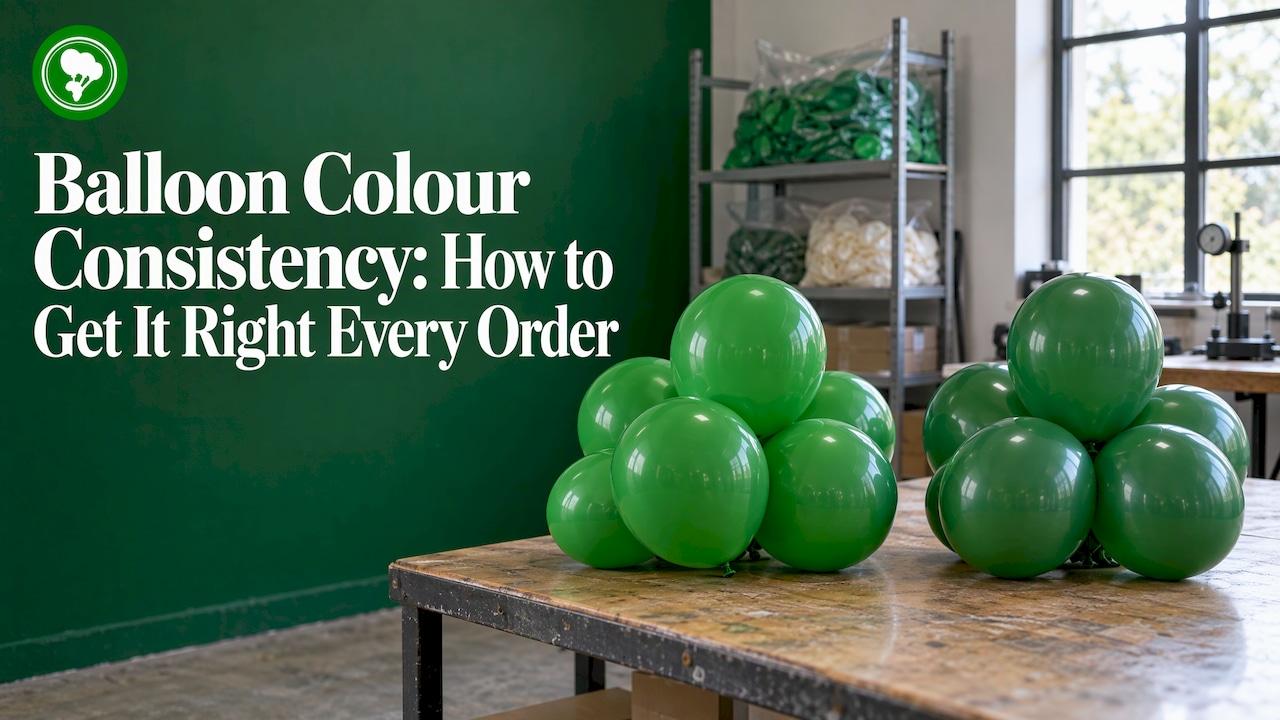
Balloon colour consistency means that the red on your first order is the same red on your second, and that every balloon in one box looks like its neighbour. You get it by choosing a supplier who makes balloons from one controlled material, by naming colours from a fixed palette, and by checking each delivery against an approved sample. Our balloons are 100% natural latex in over 50 colours and EN71 certified, so you can pick from a defined range instead of guessing at shades.
Key Takeaways
- Latex is a natural material, so small shade differences between production batches are normal, and a good supplier works to keep them tight.
- Order from a named colour chart, never from a description such as "light blue" or "brand red".
- Keep one approved sample balloon from your first order and compare every repeat delivery against it, in the same light.
- Choose three or four colours for a decoration, so any small variation is hidden inside a clear palette.
- Order the full quantity for one event or campaign in one go, so it comes from the same production run.
Table of Contents
- What colour consistency means for balloons
- Why balloon colours vary
- How to specify colours so you get what you expect
- How to check a delivery against an approved reference
- Keeping a decoration looking consistent
- How this applies to your order
- Our perspective
- Order your colours from one range
- FAQ
- Sources
What colour consistency means for balloons
There are two kinds of consistency, and buyers mix them up.
Within a batch: the balloons in one bag or carton should look the same. This matters most for arches, garlands and columns, where hundreds of balloons sit side by side.
Between orders: the balloons you reorder in March should match those you bought in January. This matters for branded campaigns, restaurant promotions and any event run in several venues.
The second kind is harder, because it depends on a different production run. A printed balloon for a fast food kiddies promotion, for example, has to look like the same brand colour in every branch and every month.

Why balloon colours vary
A balloon is a thin skin of rubber with pigment spread through it. ChemistryViews explains that the skin has to be extremely thin, uniform and elastic while still coming in every colour with an even distribution of pigment. It also notes that balloons touch the mouth, so food and consumer-goods law limits which pigments can be used.
In practice, several things can move a shade a little:
- The latex itself. It comes from rubber trees, so it is a natural material and is never perfectly identical from one lot to the next.
- Pigment and mixing. Pigment has to be dispersed evenly through the liquid latex.
- Heat and drying. Temperature and drying time during curing affect the final tone.
- Inflation. A balloon stretched to its full size looks lighter than one inflated half way, because the wall gets thinner and lets more light through.
That last point is one you control. Inflate all balloons in a display to the same size, and the colour will look more even than any other fix can make it.

How to specify colours so you get what you expect
The most common cause of a mismatch is not the factory. It is an order placed in loose words.
- Use the supplier's colour chart. Our balloon colours page shows the range, so you can order by the name on the chart and not by a description.
- Fix the size. Colour looks different on different sizes, so confirm the size on our balloon sizes page before you commit.
- Fix the finish. A matte, pearl or metallic version of the same colour will not look alike side by side, so pick one finish per colour in a design.
- For printed balloons, state the balloon colour and the print colour separately. Ink on a coloured balloon is affected by what is underneath it, so approve the combination, not just each part.
- Put it in writing. Repeat the colour name, size, finish and quantity on every order and quote.
If your brand has a strict corporate colour, tell us at the start of the project so you can agree on the closest balloon colour from the chart.
How to check a delivery against an approved reference
Keep one balloon from your first accepted order, inflated or still flat, out of sunlight. That is your reference. When the next delivery arrives:
- Inflate a few balloons from different cartons to the same size.
- Hold them next to the reference in the same light, ideally daylight or a neutral white light, not a mix of lamps.
- Look at them from the same angle, against a white background.
- Note the result with the date and the order number.
This is the visual check, and for party decor it is usually all you need. Decoration is seen from a distance by guests who are not comparing swatches.
When to measure instead
For brand-critical work, such as a national promotion, you can put a number on the difference. Colour meters report a figure called Delta E, which is the distance between two colours: the lower the number, the closer the match. A portable colour difference meter sold in South Africa takes a reference measurement, shows the Delta E to each test item and flags a pass or fail against a tolerance you set.

A reading is only as reliable as the instrument. A quality manager's guide to colour measurement says a colour specification should record how the sample is prepared, how many measurements are taken, the illuminant, the observer and the tolerance, and that the instrument should be checked by a qualified technician with traceable certification. If you do measure, write those details down once and use them for every order.
Keeping a decoration looking consistent
Even with perfect balloons, a design can look uneven. These habits help:
- Limit the palette. Three or four colours is easier to keep cohesive than seven. Our guide to balloon colour combinations shows pairings that work, and for weddings the best wedding balloon colours are chosen with photographs in mind. For help narrowing down a small, coordinated range, these wedding colour palettes are a good starting point.
- Choose one dominant colour. Let one shade carry most of the design and use the others as accents, so a small tone difference in an accent goes unnoticed.
- Use one batch per display. Do not top up an arch with balloons from a different delivery on the day.
- Inflate to a template. Use the same size every time so the shade reads evenly.
- Light the display well. Warm lamps shift blues and greens, so look at the arrangement in the venue light before guests arrive.
Where the look matters more than the budget, double stuffed balloons give a richer, more even colour in your palette.
How this applies to your order
Businesses and brands. Order the whole campaign quantity together, keep an approved sample, and quote the same colour name on every repeat. Our branded balloons are printed, so approve a sample of the finished print before the full run.
Event planners. Order everything for one event from one supply, and decide the palette before you order, not after the first delivery.
Fast food restaurants. For a kiddies menu giveaway, the balloon colour is part of the brand. Choose one or two chart colours, record the names and reorder by those names.
Private celebrations. Pick three or four colours from the chart, order all of them at once and inflate to one size.
Our perspective
We make our balloons from sustainable rubber tree sap, so they are fully natural and biodegradable, and they carry EN71 certification. Because latex is natural, the best protection against a colour surprise is a clear system: a defined range of over 50 colours, a colour named on the order, and a sample kept on file.
What we see as the sensible approach for any buyer is to settle the palette first, then the quantity, then the print. Decide on the colours before the event, order in one go, and the results look deliberate.
Balloons are one of the few decorations that carry your colours into every photograph, so it is worth the few minutes of care.
Richard CEO
Order your colours from one range
If you are planning a branded run or an event, start with our biodegradable latex balloons, see the options for branded promotional balloons and event decor, or browse colourful latex balloons and foil balloons. We supply corporate functions, weddings and promotional events through our network of decor teams.
FAQ
Why do two boxes of the same colour look slightly different?
Latex is a natural material, and small changes in the raw material, pigment mixing and curing can move a shade between production runs. Ordering the full quantity at once and comparing against a kept sample keeps the difference small.
Does the size of a balloon change its colour?
Yes. The more a balloon is stretched, the thinner the wall becomes and the lighter the colour looks. Inflate every balloon in a display to the same size for an even result.
How do I match a brand colour on printed balloons?
Choose the nearest balloon colour from the chart and approve a printed sample before the full run. State the balloon colour and the print colour separately on the order.
How many colours should I use in a balloon arch?
Three or four is easiest to keep cohesive. Let one colour dominate and use the others as accents.
Sources
- The Chemistry of Balloons (and Rubber), Part 4, ChemistryViews
- Portable Color Difference Meter PCE-XXM 30
- Colour Measurement: A Quality Manager's Guide